Last Updated: November 27, 2026
Quick Summary
To check plumber insurance coverage, ask for a current certificate of insurance and confirm the policy directly with the insurer or agent named on it. Make sure the business name matches your contract and the policy is active for the whole job.
- Ask for a current certificate of insurance in writing before work starts.
- Confirm the policy is active by calling the carrier or agent through independently sourced contact details.
- Check that the named insured matches the plumber's legal business name on your contract.
- Look for general liability and workers' compensation coverage with stated limits.
- Verify the plumber's license number through the state's official lookup tool.
Table of Contents
- How to Check Plumber Insurance Coverage Before Work Starts
- Request a Certificate of Insurance (COI) From the Plumber
- Checklist: What to Look for on a Certificate of Liability Insurance
- How to Verify a Contractor's Insurance With the Carrier or Agent
- What Does Plumbers Insurance Cover, and What Doesn't It?
- How to Check If a Plumber Is Licensed in New Jersey
- Booking Your Plumbing Job With Rich's Plumbing Heating & Air Conditioning
- Frequently Asked Questions
How to Check Plumber Insurance Coverage Before Work Starts
Before a plumber touches your pipes, you should confirm they carry active insurance, because checking their plumber insurance coverage is the safest first step.
Checking takes about 15 minutes. It also protects you from a common problem: a contractor who says they are insured but cannot prove it. Here is how to do the check step by step.
Step 1: Ask for proof in writing. Ask the plumber for a current certificate of insurance. A verbal promise is not enough.
Step 2: Review the certificate. Confirm the policy is active and the business name matches the name on your contract.
Step 3: Verify with the insurer. Call the carrier or agent listed on the certificate and confirm the policy is in force.
Step 4: Check the license. Insurance and licensing work together. Confirm the plumber holds a valid license before signing anything.
Many homeowners skip the verification step because they trust a company's reputation. That trust is reasonable, but a quick check costs little and can prevent a costly dispute later.
Watch out: A certificate of insurance can be altered or expired. Always confirm the policy directly with the insurer rather than relying on the paper alone.
Request a Certificate of Insurance (COI) From the Plumber
A certificate of insurance, often called a COI, is a one-page document that summarizes a business's insurance coverage. It names the insurer, the policy number, the coverage types, the coverage limits, and the policy dates. It is the standard way contractors show proof of coverage to customers.
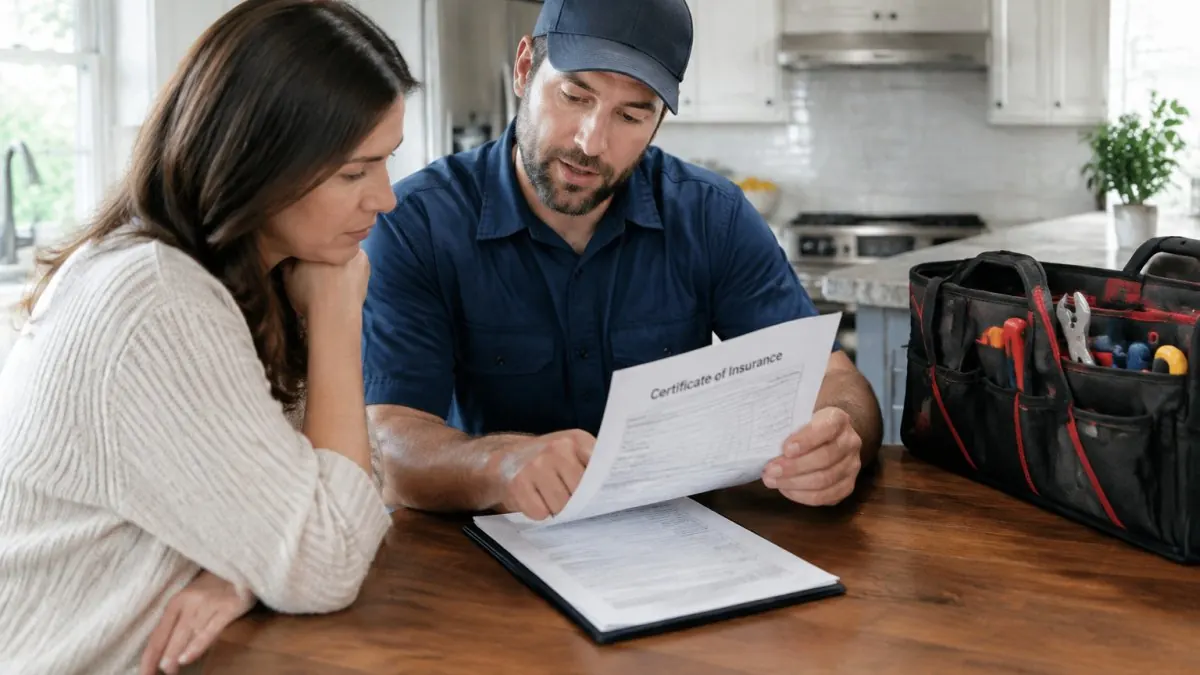
Ask for the COI before work starts, not after a problem appears. A reputable plumber will send one without hesitation. If a plumber refuses or delays, treat that as a warning sign.
When you request the certificate, ask that it list you as the certificate holder. This lets you receive notice if the policy is canceled or changes. Keep a copy with your contract and your home records.
- Request the COI by email so you have a written record
- Ask for the document to be dated and current
- Save the file with your job paperwork
Checklist: What to Look for on a Certificate of Liability Insurance
Once you have the certificate, use this checklist to review it. Each item tells you something important about the coverage.
- Business name: Does the named insured match the plumber's business name on your contract?
- Policy period: Are the effective and expiration dates current for the entire job?
- Policy number: Is a policy number listed for each coverage type?
- General liability: Does the certificate show general liability coverage with adequate limits?
- Workers' compensation: Does it show coverage for employees, which protects you if a worker is hurt on your property?
- Coverage limits: Are the per-occurrence and aggregate limits clearly stated?
- Insurer name: Is the insurance company named, so you can verify it independently?
- Certificate holder: Is your name or address listed as the certificate holder?
If any item is missing or unclear, ask the plumber to correct the certificate before work begins. A complete certificate makes the next step much easier.
Use this quick reference to check the key items on a plumber's certificate of insurance.
| Item | What to confirm | Why it matters |
|---|---|---|
| Business name | Matches your contract | Confirms the insured is the party you hired |
| Policy period | Current for the whole job | Prevents gaps in coverage |
| General liability | Shown with adequate limits | Covers property damage and injury |
| Workers' compensation | Shown for employees | Protects you if a worker is hurt on-site |
| Coverage limits | Per-occurrence and aggregate stated | Shows how much the policy pays |
| Insurer name | Named on the certificate | Lets you verify with the carrier |
| Certificate holder | Your name or address listed | Lets you receive cancellation notice |
How to Verify a Contractor's Insurance With the Carrier or Agent
A certificate only shows what the plumber says they have.
What to ask the carrier or agent. Give them the named insured, the policy number, and the policy dates from the certificate, then ask them to confirm four things:
- The policy is active on the date you call and will remain active through the job period.
- The named insured matches the plumber's legal business name on your contract, not a trade name or a different entity.
- The coverage types and limits match what the certificate shows, including general liability and workers' compensation.
- The certificate holder and any additional insured status are recorded as shown, if your project requires it.
Ask whether the policy is in force for the full job period. A policy that expires mid-project leaves you exposed, and a certificate dated before a cancellation or non-renewal can look current while the policy is no longer active.
How to source the contact independently. Start with the insurer's public website and use the policy-service or claims number listed there.
What a COI does and does not prove. A certificate of insurance is evidence of coverage at a point in time, not the policy itself.
If the plumber cannot provide proof. A reputable plumber will send a current certificate without hesitation. If the plumber refuses, delays, or sends a certificate that the carrier cannot confirm, treat that as a warning sign.
After a job-site incident. If damage or an injury occurs, document it with photos and a written description, notify the plumber in writing, and ask for the claim to be reported to their insurer.
Most agents can answer these questions in a few minutes. The call is short, but it is the step that turns a piece of paper into verified coverage.
What Does Plumbers Insurance Cover, and What Doesn't It?
Plumbers typically carry a few core types of coverage. Understanding each one helps you know what protection you actually have, and what you should ask about before work begins.
General liability insurance covers third-party property damage and bodily injury that happens during the job. If a plumber's work floods your kitchen or damages a neighbor's ceiling, this coverage can respond to those claims.
Workers' compensation covers employees who get hurt on the job.
Commercial auto insurance covers the company vehicles used to drive to your home. It matters if a company truck damages your driveway, mailbox, or garage door on arrival.
Coverage limits are stated as per-occurrence and aggregate amounts. A per-occurrence limit is the most the policy pays for one claim; the aggregate is the most it pays across the policy period.
What general liability often excludes. A general liability policy is not a warranty on the plumber's work. Common exclusions and limitations include:
- Faulty workmanship, the cost of correcting the plumber's own defective work is often excluded, even when the resulting damage to other property is covered.
- Damage to the plumber's own work, the policy may pay to repair your floor but not to redo the pipe installation that caused the loss.
- Pollution and certain water-related claims, some policies exclude or sublimit mold, pollution, and certain water-damage scenarios. Ask specifically how the policy treats water damage and mold.
- Intentional damage and normal wear and tear, these are standard exclusions on most policies.
- Certain high-risk activities, gas line work, sewer line replacement, and some excavation may be excluded or require endorsements. Ask the plumber which activities their policy covers before the job begins.
Additional insured vs. certificate holder. These are not the same thing. A certificate holder simply receives the certificate and, depending on the policy's wording, may receive notice of cancellation.
A COI is evidence, not the policy. The certificate summarizes coverage at a point in time.
Many homeowners assume every policy covers everything. That is rarely true. Read the coverage summary, ask about exclusions that match your job, and get answers in writing before work starts.
How to Check If a Plumber Is Licensed in New Jersey
Insurance protects you financially, but a license shows the plumber has met state requirements for training and competence. In New Jersey, plumbing work is regulated, and homeowners can check a plumber's status before hiring.
Start by asking the plumber for their license number. Then look up that number through the state's official licensing lookup tool. New Jersey's state licensing authorities maintain public lookup tools for licensed trades, so search the official state site for the lookup tool. Confirm the license is active, that the name matches the business, and that the license type covers the work you need.
Check that the plumber is also licensed in the way required for the specific job, since some work needs additional permits. If you are unsure, ask the plumber how they will handle permits for your project.
- Confirm the license number matches the plumber's name
- Check that the license status is active, not expired or suspended
- Make sure the license covers plumbing work, not just general contracting
Booking Your Plumbing Job With Rich's Plumbing Heating & Air Conditioning
Once you have verified insurance and licensing, you are ready to hire with confidence. Rich's Plumbing Heating & Air Conditioning is a family-owned business that has served New Jersey homeowners since 1989. We are licensed, bonded, and insured, and we offer a 60-minute response time for urgent plumbing needs.
Our 100% satisfaction guarantee means we stand behind the work we do.
Ready to get started? Tap to easily schedule service today.
Frequently Asked Questions
How do I verify a plumber's certificate of insurance?
Start by confirming the named insured matches the business name on the plumber's invoice or contract. Check that the policy dates cover the job, that general liability and workers' compensation limits are listed, and that the certificate holder is your name or address if you are requesting it. Then call the insurance agent or carrier listed on the certificate, using a phone number you look up independently rather than one printed on the document. Ask them to confirm the policy number, the effective and expiration dates, and that coverage is active. A certificate alone does not prove coverage, so direct confirmation with the agent is the step that matters most.
Can I contact a plumber's insurance company to confirm coverage?
Yes. The certificate of insurance lists the insurance carrier and the agent or broker. Contact the agent first, since they can usually confirm policy status quickly and tell you whether the policy is active on the dates of your job. Share the policy number and the plumber's business name so the agent can match the record. Insurers generally will confirm active coverage and limits to a certificate holder, but they may not share claims history or detailed policy terms without the insured's permission. Ask the plumber to authorize that disclosure if you need more detail.
What type of plumbing work may not be covered by insurance?
Many general liability policies exclude or limit certain work, so read the exclusions section of the policy or ask the agent directly. Common questions involve work on gas lines, sewer and main line replacement, water heater installations that require permits the plumber did not pull, and work performed outside the scope of the plumber's license. Some policies also exclude damage that results from faulty work the plumber later repairs, or require a separate endorsement for certain operations. Ask the plumber to confirm in writing that the planned work is covered and that the required permits are in place.
What insurance should a plumber have before working in my home?
At minimum, a licensed plumber working in your home should carry general liability insurance that covers property damage and bodily injury, along with workers' compensation for any employees. If the plumber uses vehicles for business, commercial auto coverage matters as well. Ask that you be listed as a certificate holder, and consider requesting additional insured status for larger projects. Verify that the plumber's license is active through the official New Jersey state licensing lookup before work begins, since licensing and insurance together give you the strongest protection if something goes wrong.