Last Updated: November 24, 2026
Quick Summary
The benefits of installing a smart HVAC thermostat are lower energy bills, tighter temperature control, remote access, and fewer wasted heating and cooling hours. A smart thermostat is a Wi-Fi-connected controller that learns your schedule, adjusts setpoints automatically, and reports how much runtime your HVAC system logs.
- A regular thermostat holds your setting, while a smart thermostat adjusts it automatically based on schedule and occupancy.
- Check compatibility first: heat pumps, multi-stage, dual-fuel, and zoned systems need specific models or extra wiring.
- Many smart thermostats need a common C-wire; without one, a power-stealing adapter may cause flickering or short cycling.
- Photograph and label every wire before removing the old thermostat to avoid blowing a low-voltage fuse.
- Divide installed cost after rebates by estimated annual savings to calculate your payback period in years.
Table of Contents
- What Are the Benefits of Installing a Smart HVAC Thermostat?
- Smart Thermostat vs. Regular Thermostat: What Actually Changes
- Do Smart Thermostats Work With Any HVAC System?
- How Hard Is It to Install a Smart Thermostat?
- The Disadvantages of Smart Thermostats Nobody Mentions
- Long-Term ROI: Realistic Energy Savings by Household and Climate
- Scheduling Your Smart Thermostat Upgrade With a Licensed Pro
- Frequently Asked Questions
What Are the Benefits of Installing a Smart HVAC Thermostat?
The benefits of installing a smart HVAC thermostat generally come down to lower energy bills, tighter temperature control, remote access, and fewer wasted heating and cooling hours. A smart thermostat is a Wi-Fi-connected controller that learns your schedule, adjusts setpoints automatically, and reports how much runtime your HVAC system actually logs.
Here's the part most guides get wrong. The hardware is not the benefit. The schedule behind it is.
A regular programmable thermostat can save energy too, but most people never touch the settings after week one. Smart models remove that friction. They adjust for occupancy, track energy usage data, and send maintenance reminders before a filter clogs or a capacitor fails. According to ENERGY STAR guidance on thermostats, proper setback scheduling is one of the cheapest ways to cut heating and cooling waste, and smart units automate that setback for you.
Smart Thermostat vs. Regular Thermostat: What Actually Changes
A regular thermostat holds whatever temperature you dial in. A smart thermostat changes that temperature for you, based on schedule, occupancy, and sometimes local weather. That single difference drives everything else.
The comparison breaks down like this:
| Feature | Regular Thermostat | Smart Thermostat |
|---|---|---|
| Scheduling | Manual, easy to abandon | Automated, adjusts daily |
| Remote access | None | Mobile app over Wi-Fi |
| Learning | None | Adapts to your routine |
| Energy reporting | None | Usage reports and runtime data |
| Occupancy detection | None | Sensors and geofencing |
| Maintenance alerts | None | Filter and service reminders |
Remote access is the feature homeowners underestimate. Being able to raise the setpoint from your phone while you're still at work means the system doesn't condition an empty house for three hours. Geofencing takes that further and does it without you remembering.
Before you upgrade, it helps to confirm your current unit is behaving. Our guide on the signs your thermostat is calibrated correctly walks through how to check for false readings and short cycling.
One honest limitation: smart features only pay off if the schedule matches your real routine. A smart thermostat running a bad schedule is just an expensive regular thermostat.
Do Smart Thermostats Work With Any HVAC System?
No. Smart thermostats do not work with every HVAC system, and compatibility is the first thing to check before you buy. Most models support standard forced-air furnaces and central air conditioning, but heat pumps, multi-stage equipment, dual-fuel systems, and some zoned setups need specific models or extra wiring.
Start at the wall plate. Turn off the breaker, remove the old thermostat, and photograph the terminal block. Count the labeled terminals and note the wire colors. A typical forced-air setup uses R (or Rc/Rh), W, Y, G, and often C.
The common wire, usually labeled C, provides steady low-voltage power. Many smart thermostats need one; without it, some units rely on a power-stealing adapter that can cause flickering, short cycling, or erratic behavior on certain systems. Check the wire bundle behind the wall for an unused wire you can repurpose as C.
Match the thermostat to the equipment. The table below shows the settings that most often get missed:
| Equipment type | What the thermostat must support | Common failure if mismatched |
|---|---|---|
| Single-stage furnace and AC | Standard R/W/Y/G/C wiring | None typical; basic models work |
| Heat pump with auxiliary heat | Reversing valve (O/B), aux/emergency heat, compressor lockout | Backup heat strip runs continuously; high bills |
| Two-stage furnace or AC | Y2/W2 staging terminals and staging configuration | Equipment runs only on low stage or short cycles |
| Dual-fuel (heat pump + gas furnace) | Dual-fuel changeover and outdoor sensor support | Wrong fuel source runs; comfort swings |
| Zoned system with dampers | Zoning panel compatibility and remote sensors | Zones fight each other; damper actuator damage |
| Line-voltage electric baseboard | Line-voltage thermostat, not low-voltage | Unit will not power on; wiring hazard |
Heat pumps deserve special attention. Our comparison of heat pump vs furnace systems explains how to identify your equipment by looking at the outdoor unit and the air handler.
Zoned homes with dampers and multiple temperature sensors generally need a model built for zoning. Townhomes with shared walls often benefit from remote sensors in the rooms that drift. Homes with two-wire setups or line-voltage electric baseboard heat usually need a technician or a manufacturer-supplied adapter.
Watch out: pulling the old thermostat off the wall before labeling the wires is the most common self-install mistake, and mislabeled wires can blow a low-voltage fuse or damage the new unit.
How Hard Is It to Install a Smart Thermostat?
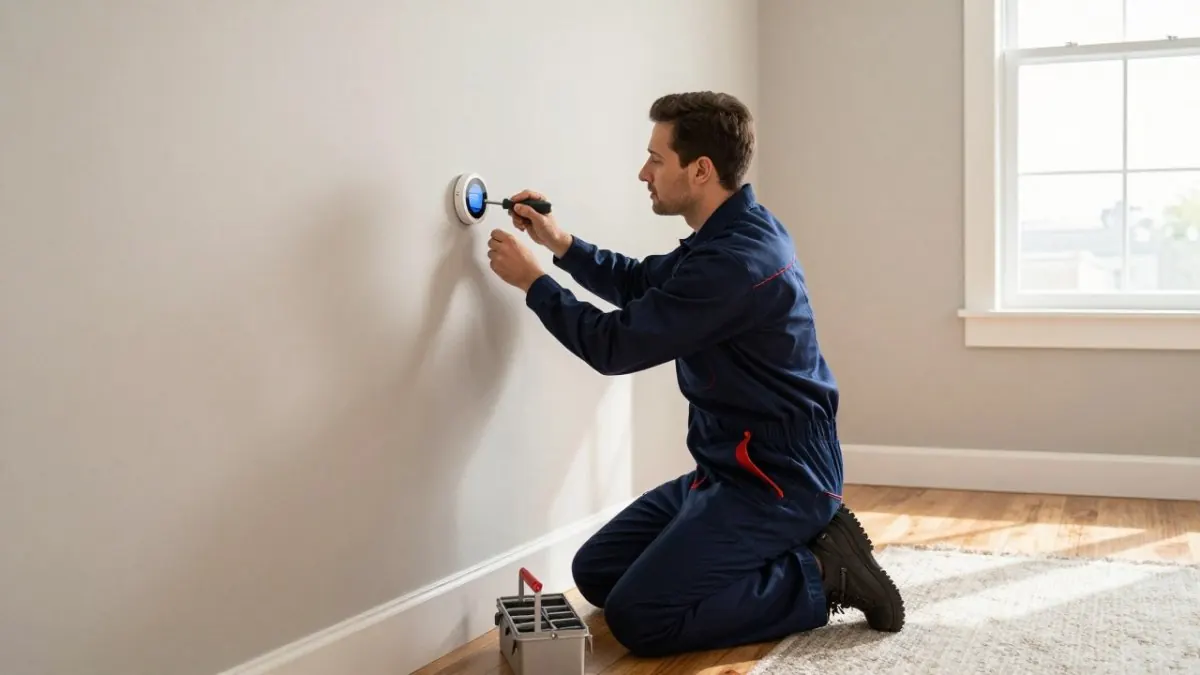
Installing a smart thermostat is a moderate DIY job for someone comfortable with low-voltage wiring, and a straightforward job for a licensed technician. The risk is not the mounting; it's misreading the terminal labels or skipping the C-wire check.
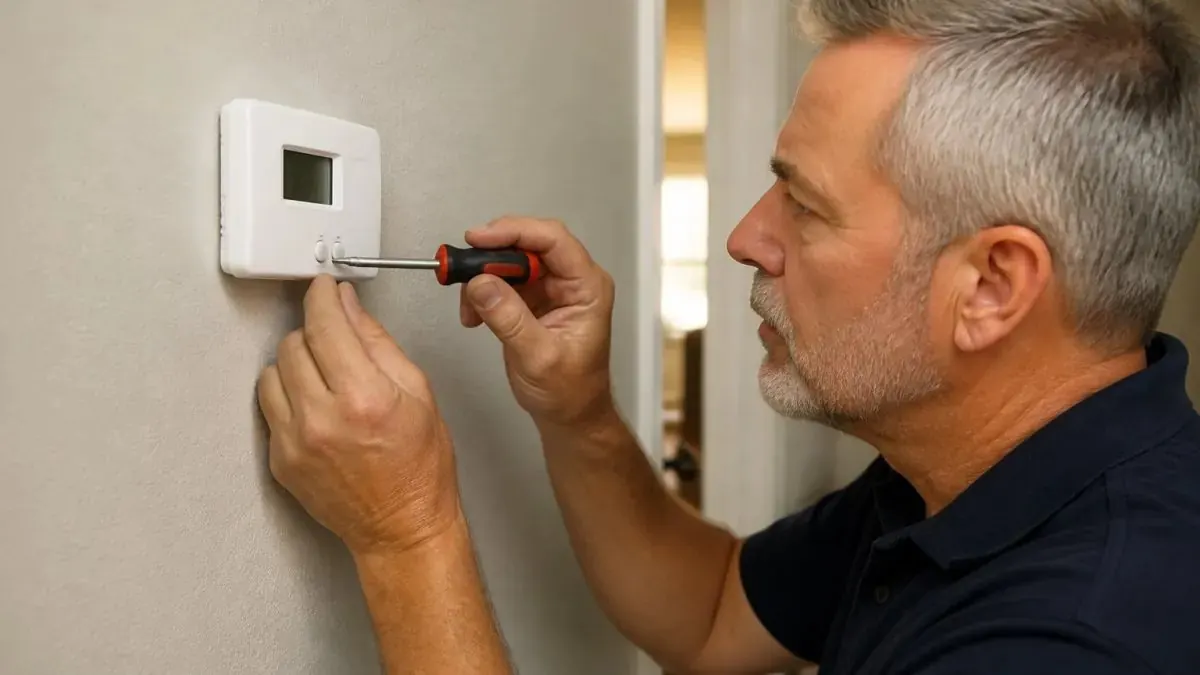
A common mistake is pulling the old thermostat off the wall before labeling the wires. Photograph the terminal block first. Then confirm the breaker is off at the panel, not just the thermostat.
The process generally runs:
- Kill power at the breaker and verify with a non-contact tester
- Photograph and label every wire on the existing terminal block
- Check for a C-wire; note whether the new unit needs one
- Mount the base plate and reconnect wires to matching terminals
- Power up and run the configuration wizard for your equipment type
- Test heating, cooling, fan, and auxiliary stages separately
Where it gets harder: homes with two-wire setups, line-voltage electric baseboard heat, or older wiring with no C terminal. Those cases usually need a technician or a manufacturer-supplied adapter. The thing nobody tells you about smart thermostat installs is that the configuration step matters more than the wiring step. Selecting "heat pump" when you have a furnace will cause problems that look like equipment failure.
The Disadvantages of Smart Thermostats Nobody Mentions
The disadvantages of smart thermostats are real: cost, connectivity dependence, data collection, and a learning curve that some households never finish. None of these are dealbreakers, but you should know them before you spend the money. Weighing those tradeoffs against the features that matter most can make the choice clearer, and Air CareSaver can help frame what to prioritize.
Cost. A smart thermostat generally costs more than a basic programmable unit, and professional installation adds labor on top. Pricing depends on model, wiring complexity, and installation requirements, so check current rates with Rich's Plumbing Heating & Air Conditioning's website for a quote.
Reliability. These devices depend on Wi-Fi and cloud services. When the internet drops, most units still run the last schedule locally, but app control and some learning features pause. Software updates occasionally change the interface.
Privacy. A smart thermostat collects occupancy patterns and temperature data. That data is what makes the automation work, but it is still household data leaving your home. Read the privacy settings during setup and turn off anything you don't need.
The learning curve. Learning thermostats need a week or two of manual adjustments before they're useful. Households that override constantly end up with a confused schedule and no savings.
A smart thermostat is a good fit for households with predictable routines and reliable Wi-Fi. It's a poor fit for a house with erratic occupancy and no interest in tuning settings.
Long-Term ROI: Realistic Energy Savings by Household and Climate
Realistic savings from a smart thermostat generally depend on what you're replacing, how much time the house sits empty, and your climate. Homes upgrading from a manual dial see more savings than homes that already run a disciplined programmable schedule. Households that are away most weekdays see more than households that are home all day.
Climate matters just as much. In a cold-winter climate, heating setbacks do most of the work. In a hot, humid summer, cooling setbacks and humidity monitoring carry the load. A heat pump needs gentler setbacks than a gas furnace, because large temperature swings can trigger inefficient backup heat.
Installed cost. Pricing depends on model, features, and installation requirements such as heat pumps, zoning, or C-wire work. DIY installation saves the labor but shifts the configuration risk onto you. For current pricing or a quote, visit Rich's Plumbing Heating & Air Conditioning's website.
Rebates and incentives. Utility rebates for smart thermostats may be available in some areas. Program details and eligibility change over time, so check your utility's current offer directly before assuming any rebate applies.
Payback calculation. Divide the installed cost (after rebates) by your estimated annual savings to get years to break even. A simple worked example: if the installed cost after a rebate is $250 and the thermostat saves $50 per year, payback is five years.
Pairing thermostat savings with envelope improvements accelerates the payback. Our article on improving home insulation for energy efficiency covers where air sealing and insulation upgrades compound with a smarter schedule.
Watch out: savings estimates that assume perfect schedule adherence rarely hold; households that override the thermostat frequently should expect a longer payback.
Scheduling Your Smart Thermostat Upgrade With a Licensed Pro
Scheduling professional installation makes sense when your system is a heat pump, has zoning, lacks a C-wire, or you simply want the configuration done right the first time. A technician verifies compatibility, confirms the wiring, and sets the equipment profile correctly, which is where most self-installs go wrong.
We handle this regularly. Rich's Plumbing Heating & Air Conditioning is family-owned and operated, with over 30 years of experience serving New Jersey, and our team is licensed, bonded, and insured. We offer estimates for most services.
If your upgrade comes with a system replacement, you can schedule AC installation or book heating installation with the same team that wires and configures the thermostat. One visit, one point of accountability.
Watch out: hiring on price alone often means the configuration step gets skipped, and a misconfigured heat pump will run backup heat all winter.
Your HVAC system only performs as well as the controls running it. If your thermostat is aging or you're tired of guessing at schedules, Rich's Plumbing Heating & Air Conditioning can help you explore your options. We bring licensed technicians and estimates on most services. Get started with Rich's Plumbing Heating & Air Conditioning and put your heating and cooling on a schedule that actually saves money.
Frequently Asked Questions
What are the downsides of smart thermostats?
The main disadvantages of a smart thermostat are upfront cost, reliance on Wi-Fi and an app, and compatibility limits with older or unusual HVAC wiring. Some models collect usage data, so privacy settings matter. Learning thermostats can also fight a household's real schedule if setup is rushed, which wastes energy instead of saving it. A professional install and a realistic temperature schedule reduce most of these issues.
Is it worth installing a smart thermostat?
It depends on how you heat and cool your home now. If you leave a programmable thermostat on one setting all day or adjust it manually, a smart thermostat's scheduling, occupancy detection, and usage reports can trim waste. Homes with erratic schedules and older equipment often see the clearest gains. Ask for an estimate and a compatibility check before buying so the upgrade fits your HVAC system.
Do smart thermostats work with heat pumps and older furnaces?
Many do, but not all. Heat pumps with auxiliary or emergency heat, two-stage furnaces, and systems with a common wire requirement need a thermostat rated for that equipment. Older two-wire setups may need an adapter or a C-wire run. A licensed technician can confirm wiring, check the model against your equipment, and install it correctly so the system runs as designed.
How hard is it to install a smart thermostat yourself?
A like-for-like swap on a modern system with a C-wire is generally a straightforward job. The job gets harder with heat pumps, multi-stage equipment, missing common wires, or confusing labels. A miswired thermostat can trip a breaker or damage control boards.