Last Updated: November 25, 2026
Quick Summary
The best smart sensors for basement flooding combine reliable water detection with alerts that actually reach you. Our top pick is the YoLink Water Leak Sensor 4 because its LoRa signal travels through concrete and floor joists where Wi-Fi often fails. Basement flooding is a specific problem, so sensors that work in a kitchen often go quiet behind a concrete wall.
- LoRa radios penetrate concrete and floor joists better than Wi-Fi, but require a hub.
- A practical unfinished basement setup uses four sensors at the sump pit, water heater, floor drain, and damp wall.
- If you buy only one sump-pump device, buy a high-water alarm over a leak sensor.
- Pair any sensor with mobile app alerts since some alarms are too quiet to hear upstairs.
- A UPS on the router and modem keeps cloud notifications alive during a power outage.
Table of Contents
- What are the best smart sensors for basement flooding?
- How we evaluated basement water leak sensors
- Top picks for basement water leak sensors
- Smart water sensor Wi-Fi alerts and basement connectivity
- Water leak alarms: volume, audibility, and false alarms
- Water leak detector with automatic shut-off valve options
- Basement placement plans for sump pumps, water heaters, and floor drains
- Booking a basement leak inspection with Rich's Plumbing Heating & Air Conditioning
- Frequently Asked Questions
What are the best smart sensors for basement flooding?
The best smart sensors for basement flooding combine reliable water detection with alerts that actually reach you. Our top pick is the YoLink Water Leak Sensor 4 because its LoRa signal travels through concrete and floor joists where Wi-Fi often fails.
Basement flooding is a specific problem, sensors that work in a kitchen often go quiet behind a concrete wall. Below, we break down what works and where to place each unit.
Quick comparison: sensors, alerts, and power
| Sensor | Best for | Connectivity | Local alarm | Power |
|---|---|---|---|---|
| YoLink Water Leak Sensor 4 | Concrete walls, floor joists | LoRa (hub required) | Yes | Battery |
| D-Link SW-A11KT | Two-sensor starter coverage | Wi-Fi hub | Yes | Battery |
| GoveeLife Water Leak Detector | Whole-basement coverage | Wi-Fi | Yes | Battery |
| SwitchBot WiFi Leak Detector | Budget single-spot | Wi-Fi | Yes | Battery |
How we evaluated basement water leak sensors
We judge basement water leak sensors on one question first: will the alert reach you when the basement is dark, empty, and behind a closed door?
Our criteria:
- Signal reliability through concrete, joists, and ductwork
- Alert speed from water contact to phone notification
- Alarm volume loud enough to hear from upstairs
We also weigh false alarms, a sensor that chirps every time humidity rises gets unplugged within a month. For finding leaks sensors may miss, see our guide on how to identify hidden water leaks.
Top picks for basement water leak sensors
Three sensors cover most basements, each winning on a different trade-off.
YoLink Water Leak Sensor 4: best for concrete and floor joists
The YoLink Water Leak Sensor 4 is our top pick for basements because its LoRa radio reaches through concrete and floor joists, according to The Basement Guide's water leak detector review. Even with reliable early warnings, a leak can become a flood, so knowing how to clean up safely matters; this guide can help you prepare for that next step.
It requires a hub, which adds cost and one more device to power. That is the trade-off we accept for signal reliability. Best for: basements with thick walls or long runs from the router. Skip if: you refuse to add a hub.
D-Link SW-A11KT: best starter kit for two-sensor coverage
The D-Link SW-A11KT ships with two sensors, and Wirecutter describes its operation as quick and reliable. Two sensors let you cover the water heater and the floor drain without buying twice.
The catch: Wirecutter's smart leak detector testing notes it costs more than other picks. Best for: homeowners who want a proven pair out of the box. Skip if: you need to cover five or more spots.
GoveeLife Water Leak Detector: best for covering a whole basement
The GoveeLife Water Leak Detector can be a practical choice for covering a larger basement with several units.
More sensors mean better detection range, but each one needs its own spot and battery check. Best for: large or cluttered basements. Skip if: you want one premium unit instead of many.
Smart water sensor Wi-Fi alerts and basement connectivity
Smart water sensor Wi-Fi alerts only work if the sensor holds a signal, and basements are the worst place in the house for Wi-Fi.
The deeper issue is what happens after detection. A cloud-based alert depends on the sensor reaching the hub or router, the router reaching the internet, and the provider pushing the notification to your phone, any break means no alert.
What degrades the signal below grade
- Concrete and rebar. Poured foundation walls and slabs attenuate Wi-Fi more than wood-frame interior walls. A sensor on the far side of a foundation wall from the router may be effectively out of range.
- Distance and floors. Every floor and duct run between the router and the sensor costs signal. A basement on the opposite corner of the house from the router is a common failure point.
- Metal ductwork and appliances. HVAC trunks, water heaters, and metal shelving create shadow zones. A sensor behind a furnace or under a metal shelf can lose signal even when the rest of the basement is fine.
Three fixes that work in practice
- Add a mesh node or access point in the basement stairwell. This is the cheapest fix for a Wi-Fi sensor that keeps dropping. Place the node high and central, then re-test the sensor.
- Choose a LoRa or hub-based system for concrete walls. LoRa radios trade bandwidth for range and penetrate concrete and floor joists better than Wi-Fi. The trade-off is a required hub and, in some systems, a subscription for remote alerts.
- Test before you trust. Place the sensor, trigger a test alert from the app, then repeat the test with the basement door closed and again with your phone off Wi-Fi. If any of those tests fails, fix the signal path before you rely on the device.
Watch out: a sensor that reports "online" can still fail to deliver a push notification if your phone's battery optimization is killing the app. Check notification settings on iOS and Android, and confirm the alert arrives with the phone locked.
Local alarms versus cloud notifications
A local alarm works without internet, hub, or subscription, but only helps if someone is home and within earshot. A cloud notification reaches your phone anywhere, but depends on the full chain from sensor to phone.
The reliable pattern is both: a loud local alarm for anyone home, plus app alerts for when you are away. If you travel or the basement is a vacation property, add a cellular backup so an outage does not silence the alert.
Power outages and internet loss
Most battery-powered leak sensors keep detecting during a power outage, but the alert path changes. If the router and modem lose power, cloud notifications stop even though the sensor still works and its siren still sounds. A UPS on the router and modem keeps the network alive; a hub with cellular backup keeps alerts flowing longer.
Water leak alarms: volume, audibility, and false alarms
Water leak alarms vary widely in volume, and some are too quiet to hear from the floor above. Alarm volume differs considerably between models, so check it before you buy.
That matters in a basement, if you are asleep upstairs, a quiet chirp will not wake you. Pair any sensor with mobile app alerts. On false alarms, mount sensors on a dry spot with probes touching the floor, not in a damp corner.
Water leak detector with automatic shut-off valve options
A water leak detector with automatic shut-off valve pairs a sensor with a motorized valve that closes your main line when water is detected, the difference between a small puddle and a flooded basement.
Before you buy one, know how to close your main valve by hand as a fallback. Our step-by-step guide on how to shut off the main water valve walks through it.
Basement placement plans for sump pumps, water heaters, and floor drains
Placement decides whether a sensor works. One sensor in the middle of the floor misses the three spots where water actually starts, and a sensor in a damp corner will nuisance-trip until you unplug it.
Where water actually starts
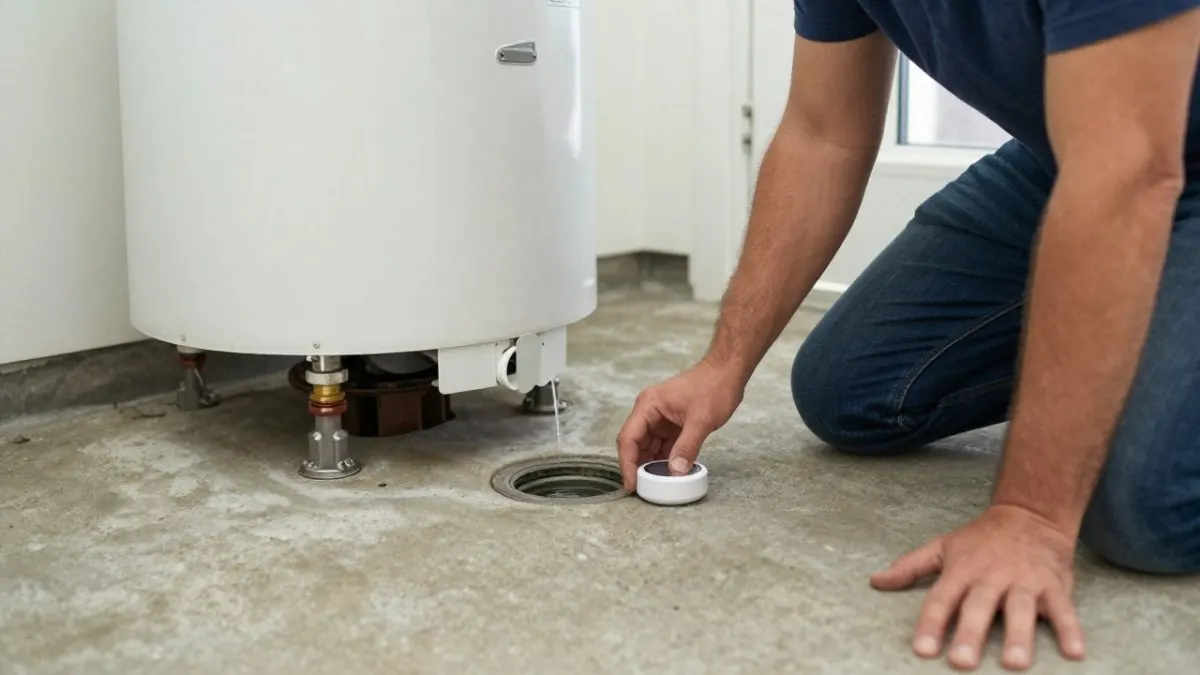
Most basement water intrusion begins at a few fixed points: the sump pit, water heater base, floor drain, washing machine hoses, the floor-wall joint, and any floor-level cleanout.
Mount every sensor so the probes touch the floor and the body sits on a dry surface. Water follows the slope of a concrete floor, so place the unit on the low side of the equipment.
Layout by basement type
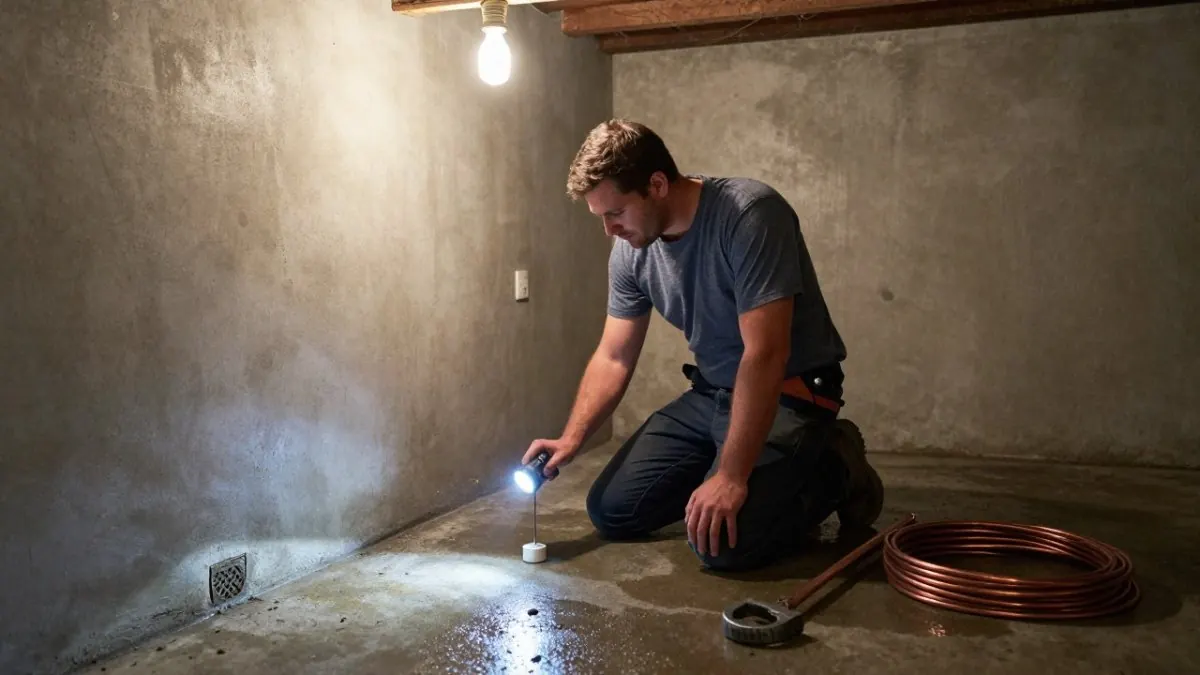
Unfinished basement with a sump pit and mechanicals. Four sensors is a practical minimum: one on the sump pit rim, one at the water heater base near the drain valve, one on the low side of the floor drain, and one at the base of the wall on the side where you have seen dampness. Add a fifth behind the washing machine if laundry is down there.
Walkout or split-level basement. Water often enters at the door threshold and along the wall on the downhill side. Place one sensor at the base of the walkout door, one along the downhill foundation wall, and one at the floor drain.
Basement with a floor-level cleanout or sewage ejector pit. Add a sensor at the base of the cleanout and one at the ejector pit rim.
Sump-pump failure needs a different device
An ordinary water leak sensor detects water that has already reached the floor. A sump pump can fail without putting water on the floor until the pit overflows, a stuck float, tripped breaker, burned-out motor, or clogged discharge line.
For most homes with a sump pump, buy both: a leak sensor on the pit rim to catch seepage, and a high-water alarm in the pit to catch the pump not running.
Match the sensor to the flooding scenario
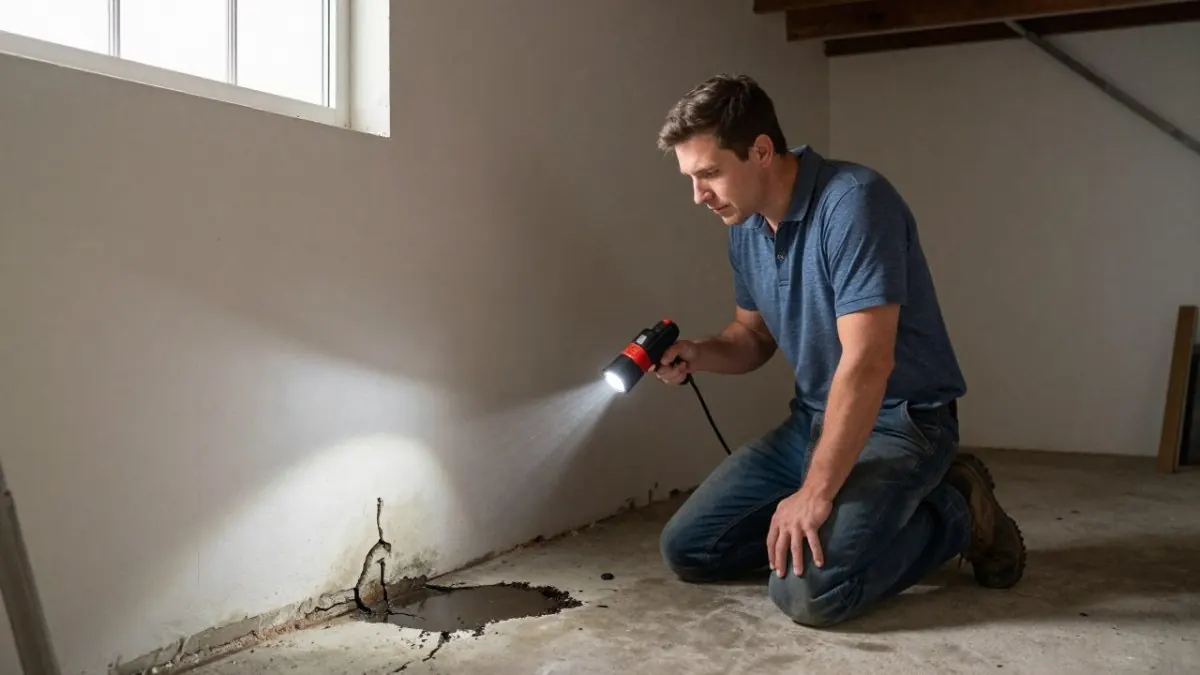
- Slow seepage through a foundation wall or floor crack. Water may take hours to spread. A spot sensor at the wall base alerts while the wet area is still small.
- Burst supply line or failed washing machine hose. Water can pool inches deep in minutes. A spot sensor alerts quickly, but only a manual or automatic shutoff valve stops the flow. Pair the sensor with a shutoff valve if the basement is finished.
- Rapid groundwater intrusion during heavy rain. Water often enters at the floor-wall joint and floor drain at once. Sensors at both points, plus a high-water alarm in the sump pit, give the earliest warning.
Understanding why basements flood helps you target these spots; our guide on common causes of basement flooding covers the usual culprits.
Booking a basement leak inspection with Rich's Plumbing Heating & Air Conditioning
Sensors catch water after it starts. If sewage backup is a risk in your basement, our guide on preventing sewage backup explains the steps. For wider device options, compare our picks against the best water leak detection devices for homeowners.
A sensor is only as good as its placement and the plumbing behind it. If your basement has leaked before, or you want a professional to confirm the setup, Rich's Plumbing Heating & Air Conditioning offers estimates for most services and a 100% satisfaction guarantee.
Frequently Asked Questions
Where should you place water leak sensors in a basement?
Start at the sump pump pit, water heater base, washing machine, and floor drain. Add sensors under the kitchen and bathroom supply lines if they sit above the basement. Place each sensor on the floor within the path water would travel, not on a shelf. For a finished basement, put one near the wall baseboard on the low side of the room. A single sensor covers a small area, so plan two to four units for a typical basement.
Do smart water leak detectors work without Wi-Fi?
Most Wi-Fi models lose app alerts when the connection drops, but many still sound a local alarm. That matters in basements where concrete and floor joists weaken Wi-Fi. YoLink's LoRa signal is cited as reaching through concrete and floor joists, which is why it suits below-grade rooms. If you want alerts during an outage, pair a Wi-Fi sensor with a battery-backed hub or choose a model with a loud local alarm as a backup.
Can a water leak detector shut off the water automatically?
A leak sensor alone cannot close a valve. Automatic shut-off requires a motorized valve controller wired to your main line and paired with a sensor or hub. The sensor triggers the controller, which closes the valve. This is worth the cost if your basement holds a water heater, laundry, or finished space. Ask a licensed plumber to confirm your main valve can accept a controller before you buy one.
What features should you look for in a basement flood sensor?
Prioritize alarm volume you can hear upstairs, a reliable signal through concrete, and battery life measured in years, not months. Look for freeze and temperature detection if pipes run along exterior walls. Check the water-resistant rating on the sensor body and whether the app sends push notifications when you are away. A hub requirement adds cost, so factor that into the total.
How do you detect a water leak in a basement?
Watch for damp spots on the floor, a musty smell, or a sump pump that runs more often than usual. Check the water heater base, washing machine hoses, and floor drain for standing water. A smart sensor catches slow drips you would miss on a quick walk-through. If you find active water or a failed sump pump, call a licensed plumber rather than waiting for the next storm.