Last Updated: November 23, 2026
Quick Summary
The signs of a slab leak under foundation include unexplained spikes in your water bill, warm spots on the floor, the sound of running water when nothing is on, cracks in walls or flooring, damp carpet, and dropping water pressure. Any one of these warrants a closer look, since a slab leak is a plumbing leak in the water or sewer lines beneath your home's concrete foundation.
- Turn every fixture off and check the meter dial; if it keeps moving, water is escaping somewhere.
- Professional detection visits usually take one to two hours rather than a full day of exploratory demolition.
- Fixing a slab leak usually takes a few hours to a couple of days, depending on the repair method.
- Standard homeowners policies typically exclude damage from long-term seepage, leakage, or repeated slow leaks.
- Rich's Plumbing Heating & Air Conditioning offers a 60-minute response time for urgent calls and estimates for most services.
Table of Contents
- What Are the Signs of a Slab Leak Under Foundation?
- Slab Leak Symptoms You Should Never Ignore
- How Slab Leak Detection Actually Works
- What Causes a Slab Leak in the First Place?
- How Long Does It Take to Fix a Slab Leak?
- Why Ignoring a Slab Leak Costs More Than Fixing It
- Schedule Your Slab Leak Inspection Today
- Frequently Asked Questions
What Are the Signs of a Slab Leak Under Foundation?
The signs of a slab leak under foundation include unexplained spikes in your water bill, warm spots on the floor, the sound of running water when nothing is on, cracks in walls or flooring, damp carpet, and a dropping water pressure.
A slab leak is a plumbing leak in the water or sewer lines running beneath your home's concrete foundation. Left alone, it can undermine the slab and the structure above it.
Below, we'll walk through the warning signs, how detection works, and what a repair really involves.
Slab Leak Symptoms You Should Never Ignore
Most slab leaks announce themselves through your senses before they ever show up as a big repair bill. A common mistake is dismissing a warm patch or a faint hiss as "nothing." In practice, these early clues are the cheapest moment to act.
Here are the core slab leak symptoms to watch for:
- A water bill that jumps with no change in habits
- Warm or hot spots on the floor
- The sound of running water when taps are off
- Low or dropping water pressure
Warm Spots, Running Water Sounds, and Other Early Warnings
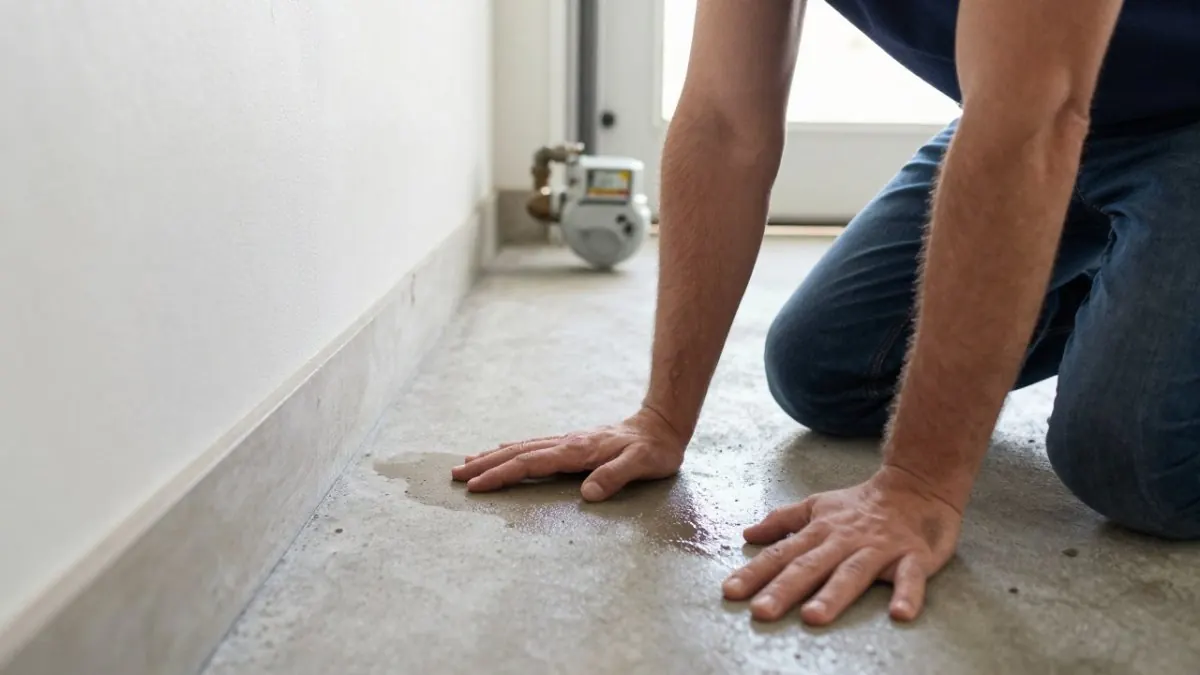
A hot spot underfoot is one of the clearest early warnings. It points to a leak in a hot water line heating the concrete from below.
Watch your water meter too. Turn every fixture off and check the meter dial. If it keeps moving, water is escaping somewhere. That's your cue to shut off the main water valve before things get worse.
Cracks, Damp Carpet, and Foundation Warning Signs
Cracks are where a slab leak starts threatening structural integrity. Hairline cracks can be normal settling. Cracks that widen, or that appear alongside damp flooring, are not.
Other foundation warning signs include:
- Damp or spongy carpet near interior walls
- Warped or buckling flooring
- Baseboards pulling away from the wall
- Doors and windows that suddenly stick
These point to water intrusion and possible foundation settlement. If you're also seeing water in the basement, our guide to common causes of basement flooding explains what's driving it.
How Slab Leak Detection Actually Works
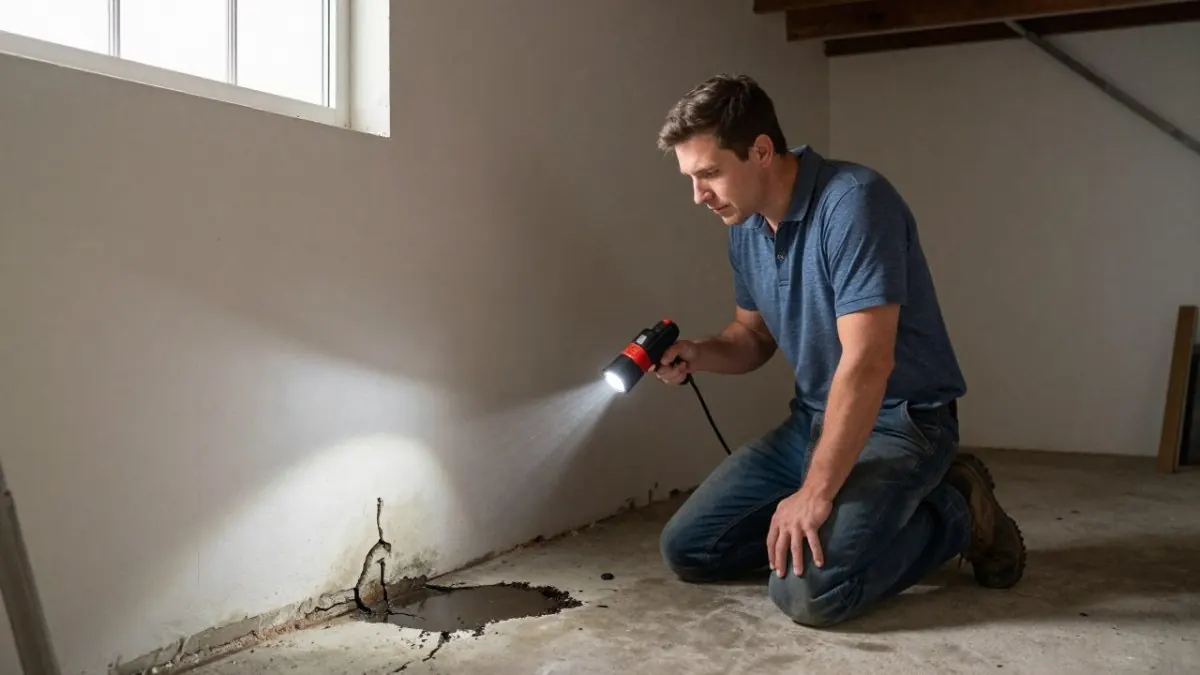
Slab leak detection is the process of pinpointing a leak beneath the concrete without tearing up your whole floor. Pros use non-invasive tools to locate the exact spot first, then open only what's necessary.
Here is what each method actually does, in the order a technician typically uses them:
- Acoustic leak detection: A ground microphone or listening disc is placed on the slab, and the technician listens for the specific frequency of water escaping a pressurized line. The sound changes with pipe material and depth, a pinhole in copper under 4 inches of concrete sounds different from a joint failure in galvanized steel. Technicians often pressurize the line with air or water and use a correlator that compares sound arrival times at two sensors to calculate the leak's location within a few inches.
- Thermal imaging: An infrared camera reveals temperature differences on the floor surface. A hot-water line leak shows as a warm plume; a cold-line leak can show as a cool patch, especially in humid weather. Thermal imaging works best on bare concrete or tile, carpet and hardwood insulate the slab and blur the reading.
- Pressure testing: The technician isolates sections of the supply system with valves or test plugs, pressurizes each segment, and watches a gauge. A drop confirms which line is losing water. This step separates a supply-line leak from a drain-line leak, which changes the repair approach entirely.
- Moisture detection: Pin-type and pinless meters map damp areas in the slab and surrounding flooring. Moisture mapping is less about finding the leak and more about defining its footprint, how far water has traveled under the slab, which tells you whether flooring, baseboards, or adjacent rooms are at risk.
Used together, these tools turn a guessing game into a precise diagnosis. That's plumbing diagnostics done right, and it's why a professional detection visit usually takes one to two hours rather than a full day of exploratory demolition.
DIY Checks vs. Professional Leak Detection Equipment
Best for: confirming a suspected leak and monitoring hotspots. Skip if: you've already got a confirmed leak and need it located and fixed.
Watch out: if you have confirmed a leak with the meter test, do not start probing, drilling, or chipping the slab to find it yourself.
If you want to compare homeowner-grade sensors and placement tips first, our guide to the best water leak detection devices is a good starting point.
What Causes a Slab Leak in the First Place?
Understanding what causes a slab leak helps you judge your risk. The usual culprits are age and pressure working together on buried pipes.
- Pipe corrosion: older copper and galvanized lines wear thin over time
- Pinhole leaks: tiny corrosion holes that grow under constant pressure
- Shifting soil: ground movement stresses pipes under the slab
- Poor installation: abrasive contact or bad joints fail early
- High water pressure: constant pressure accelerates wear
Homes with older copper piping or a slab foundation face the highest odds. The sub-slab plumbing is out of sight, so problems build quietly.
How Long Does It Take to Fix a Slab Leak?
Fixing a slab leak usually takes a few hours to a couple of days, depending on the repair method and how hard the leak is to reach. Detection itself often takes an hour or two.
| Repair Method | Typical Timeline | Best For |
|---|---|---|
| Spot repair | A few hours to a day | A single accessible pinhole leak |
| Pipe reroute | One to two days | Older lines prone to repeat leaks |
| Full repipe | Two to several days | Widespread corrosion |
How long a slab leak repair takes depends on what the detection finds and the repair method needed. Ask a licensed plumber for an estimate before work begins.
Why Ignoring a Slab Leak Costs More Than Fixing It
A small leak under a slab never stays small. Water keeps working on the concrete, the soil, and your foundation every single day.
Here is how a slab leak typically escalates:
- Weeks 1-4: The invisible stage. Water escapes under the slab and wicks into the soil. The only signs are a rising water bill, a faint running-water sound, or a warm spot on the floor. Repair at this stage is usually a spot fix or reroute.
- Months 1-3: The flooring stage. Moisture reaches the slab surface and migrates into carpet, hardwood, or tile adhesive. Carpet feels damp or spongy; hardwood cups or buckles; tile grout darkens. Now you are paying for flooring replacement on top of the plumbing repair.
- Months 3-12: The structural stage. Saturated soil under the slab expands and softens. The slab can settle unevenly, which shows up as new cracks in drywall, doors that stick, and baseboards pulling away. Foundation repair is a separate trade and a separate bill, often the largest line item in the whole event.
- Year 1 and beyond: The mold and erosion stage. Persistent moisture feeds mold in flooring, drywall, and crawl spaces. In severe cases, water erodes soil under the slab and creates voids that accelerate settlement. At this point the leak is no longer the main problem, the damage it caused is.
The hidden costs add up:
- Higher water bills month after month
- Foundation damage that needs its own repair
- Mold growth and damaged flooring
- A worse leak that eventually floods a room
Patching only the symptom can lead to repeat repairs, while addressing the source can help protect your home. If you want to stop paying for the same repair twice, our guide to avoiding recurring plumbing repair costs lays out the prevention steps.
Does Homeowners Insurance Cover a Slab Leak?
This is the question most homeowners ask second, right after "how much will this cost?", and the answer is more nuanced than a yes or no. Standard homeowners policies generally cover sudden and accidental water damage, such as a pipe that bursts and soaks flooring (Am I Covered?).
A few practical points most guides skip:
- Document early. Photograph the damp area, keep the water bills showing the spike, and save the plumber's written detection report. Insurers weigh evidence of a sudden event versus a neglected one.
- Read the exclusion section, not the summary. The words "constant or repeated seepage or leakage" appear in most standard forms and are the basis for most denials.
- Ask about service line coverage. Many carriers now offer an optional endorsement for buried water and sewer lines. It is usually inexpensive relative to the repair and is often not included in a base policy.
- Mold coverage is usually capped or excluded. Even when the water damage is covered, mold remediation often has a separate, low sublimit.
Coverage varies by carrier and policy form, so confirm the specifics with your insurer before assuming a slab leak is or isn't covered. The earlier you document, the stronger your position either way.
Schedule Your Slab Leak Inspection Today
Catching the signs of slab leak under foundation early is the difference between a quick fix and a foundation problem. If anything on this list sounds familiar, don't wait for the water to find its way out.
Rich's Plumbing Heating & Air Conditioning is family-owned and operated, with over 30 years of experience serving New Jersey.
Get started with Rich's Plumbing Heating & Air Conditioning and schedule your slab leak inspection today.
Frequently Asked Questions
Can you have a slab leak and not know it?
Yes. Many slab leaks start as pinhole leaks in copper piping under the concrete, and the water can seep into the soil or moisture barrier for weeks before you notice anything. Early clues are easy to miss: a small jump in the utility bill spike, a faint sound of running water when no fixtures are on, or a slightly warm patch on the floor. Watching your water meter with all fixtures off is one of the simplest ways to catch a hidden leak early.
Will homeowners insurance cover a slab leak?
Coverage varies by policy. Most standard homeowners policies cover sudden and accidental water damage, such as warped flooring or damp carpet caused by a burst pipe, but they often exclude the cost of accessing the leak itself, like breaking through the concrete slab. Some insurers offer limited coverage for slab access or resulting foundation settlement. Review your policy language and ask your adjuster specifically what is covered before authorizing repairs.
How urgent is a slab leak?
Treat it as urgent. A slab leak under your foundation steadily erodes soil, raises hydrostatic pressure, and can lead to foundation settlement, structural cracks, and mold growth. Left alone, a small pinhole leak can turn into a full pipe failure and major water damage. Shut off the water supply if the leak is active and call a licensed plumber for slab leak detection as soon as you suspect one.
How can you check for a water leak under a concrete slab?
Start with a water meter test: turn off every fixture and appliance that uses water, then watch the meter for 15 to 30 minutes. Any movement points to a leak in the plumbing system. You can also listen for running water near the floor, feel for warm spots on the slab, and check for damp carpet or warped flooring. These DIY checks narrow things down, but thermal imaging and acoustic leak detection give a precise location before any concrete is opened.