Last Updated: November 16, 2026
Quick Summary
The cost to replace a water heater element typically runs $225-$525 for a single standard element installed by a pro, covering the part, service call, diagnosis and labor. DIY parts-only cost usually lands between $15 and $120 depending on the element and whether you buy a kit.
- A standard screw-in element costs $15-$60, while a kit with gaskets and wrench runs $40-$120.
- Service calls run $75-$150 and diagnosis adds $50-$125, sometimes waived if you approve the repair.
- Installation labor runs $100-$250 for a clean, accessible swap and more if the element is stuck.
- Most standard household electric heaters use a 4500-watt upper and lower element pair.
- Confirm the element is the culprit before buying, since a bad thermostat or tripped breaker mimics the same symptoms.
Table of Contents
- What Drives the Cost to Replace an Electric Water Heater Heating Element
- Water Heater Element Replacement Cost: An Itemized Breakdown
- Hot Water Heater Element Price by Type and Wattage
- 4500 Watt Water Heater Element Replacement: The Most Common Spec
- Water Heater Repair Cost: When the Element Is Not the Only Problem
- Diagnose Before You Buy: Signs of a Failed Element
- DIY vs Professional Replacement: A Decision Matrix
- Schedule Your Element Replacement With a Licensed Pro
- Frequently Asked Questions
What Drives the Cost to Replace an Electric Water Heater Heating Element
The cost to replace electric water heater heating element work typically breaks into two buckets: the part itself and the labor to install it. Diagnosis, access, and the condition of the tank drive the rest.
Replacing a heating element is rarely as simple as the sticker price suggests. A screw-in element sitting on a hardware store shelf looks cheap. Getting to it, testing it, and confirming it's actually the failed component takes time and know-how.
Here's the core tension most guides skip: the part is cheap, but guessing wrong is expensive. Buy the wrong wattage or skip diagnosis, and you've spent money on a fix that doesn't solve the problem.
Below, we'll show you exactly what each cost line represents, how to diagnose before you buy, and when to call a licensed pro instead of reaching for a wrench.
Parts Cost: What a Replacement Element Actually Runs
A replacement heating element is generally one of the less expensive parts on an electric water heater, and pricing depends on the element type, wattage and kit contents. For current prices or a quote, visit Rich's Plumbing Heating & Air Conditioning's website.
What most guides miss is the compatibility trap. Elements come in different wattages, voltages, and mounting styles. Buy a 5500-watt element for a tank wired for 4500 watts and you've created a safety problem, not a repair.
Labor Cost: Service Call, Diagnosis, and Install Time
Labor is often a large share of the total. A service call covers travel and the initial look. Diagnosis adds time to test the element, thermostat, and power supply. Installation adds more once the tank is drained and the old element is out.
Pricing depends on the job conditions, access to the heater, and how corroded the old element is. A stuck element in a sediment-heavy tank can turn a quick swap into a longer fight.
Water Heater Element Replacement Cost: An Itemized Breakdown
Water heater element replacement cost generally comes down to four line items: the part, the service call, diagnosis time, and installation labor. Each one can scale differently depending on your tank and your situation.
| Cost Line | What It Covers | Typical DIY Range | Typical Pro Range | What Moves It Up or Down |
|---|---|---|---|---|
| Replacement element | The part itself | $15-$60 for a standard screw-in element; $40-$120 for a kit with gaskets and wrench | Same part cost, often marked up 10-30% | Wattage, mounting style, kit vs. single, specialty or low-profile style |
| Service call | Travel and initial assessment | $0 | $75-$150 | Distance, time of day, emergency or after-hours rate |
| Diagnosis | Testing element, thermostat, power supply, wiring | $0 (your time) | $50-$125, sometimes waived if you approve the repair | Number of components checked, whether voltage testing is needed |
| Installation labor | Drain, remove, install, refill, restore power | $0 (your time) | $100-$250 for a clean, accessible swap; more if the element is stuck | Corrosion, access, sediment buildup, whether both elements are replaced |
Two line items often surprise homeowners. First, the diagnostic fee: some shops charge it separately, so ask about it before any work begins. Second, extra labor for a stuck element: an element seized by scale or corrosion can add time to the job.
Watch out: a quote that covers only the part and labor can miss the service call and diagnostic fee, so ask for the all-in number in writing before you schedule.
The part is predictable. Everything else depends on your heater and your home.
Typical Pro Cost Ranges for Water Heater Element Replacement Line Items
Hot Water Heater Element Price by Type and Wattage
Hot water heater element price generally depends on wattage and style. Lower-wattage screw-in elements are often the lower-cost option, while higher-wattage and specialty elements can cost more.
Three factors set the price:
- Wattage: Wattage is one factor that affects element selection.
- Mounting style: Mounting style varies by element type.
- Kit vs. single: Element kits include gaskets and tools in addition to the element.
Match the replacement to your tank's original spec. The label on the heater tells you the wattage and voltage you need.
4500 Watt Water Heater Element Replacement: The Most Common Spec
A 4500 watt water heater element replacement is a common job in residential electric tanks. Most standard household electric heaters run a 4500-watt upper and lower element pair.
Two elements in the same tank often age together, so when one fails, it can be worth checking the other. Replacing both in one visit can save a second service call later, and whether to do so is a judgment call.
Watch out: installing an element with the wrong wattage for your wiring can trip breakers or damage the circuit. Always match the spec on the tank's label.
Water Heater Repair Cost: When the Element Is Not the Only Problem
Water heater repair cost climbs fast when the element isn't the only issue. A failed element is simple. A failed element plus a corroded tank, a bad thermostat, or a leak is a different conversation.
Age matters here. If your heater is near the end of its service life, repairing it may not be worth the money. Our guide on water heater lifespan covers the signs of failure and when replacement makes more sense than repair. If you're weighing emergency repair against a full replacement, our repair versus replacement guide walks through the decision.
The honest answer: sometimes the repair is the right call, and sometimes it's throwing money at a tank that's already done.
Diagnose Before You Buy: Signs of a Failed Element
Signs of a failed heating element show up as no hot water, insufficient hot water, or water that heats slowly. Before buying a part, confirm the element is actually the culprit.
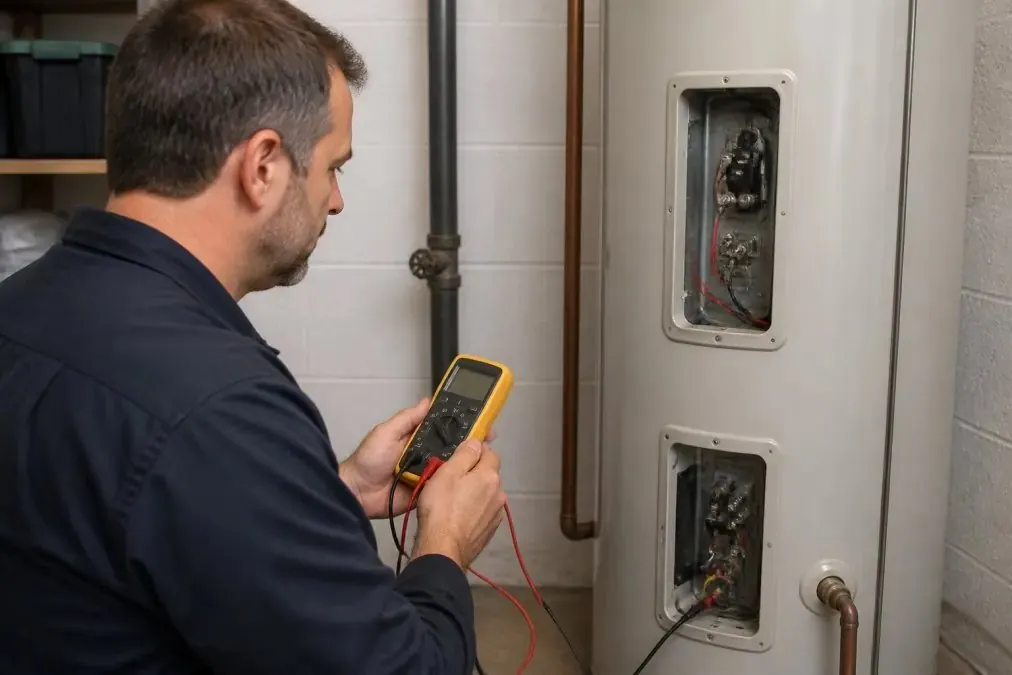
Work through the diagnosis in order. Skipping a step can lead homeowners to buy more than one part for a single problem.
- Confirm power is off before you open anything. Flip the dedicated breaker at the panel and verify with a non-contact voltage tester at the heater. If the breaker is tripped, reset it once and see whether hot water returns; a breaker that trips again points to a wiring or element fault, not a thermostat.
- Check the breaker and the high-limit switch. A tripped high-limit (red reset button) on the upper thermostat cuts power to the whole heater. If it's tripped, reset it and watch for a repeat, a repeat trip usually means a bad thermostat or element.
- Test for voltage at the element terminals. With the breaker on and the tank calling for heat, a multimeter should read roughly 240 volts across the upper element terminals (or 120 volts on a 120-volt unit). No voltage means the problem is upstream, breaker, wiring, or thermostat, not the element.
- Test the element itself. With power off, disconnect the wires and measure resistance across the element terminals. A good element reads a finite resistance (often in the 10-16 ohm range for a 4500-watt, 240-volt element); an open reading (OL) means the element is burned out. Then check continuity from each terminal to the tank shell, any continuity means the element is grounded and must be replaced.
- Rule out sediment. Rumbling, popping, or a tank that heats slowly but still produces some hot water often points to sediment rather than a dead element. Flushing the tank is cheaper than replacing a working element.
A common mistake is replacing the element when the real problem is the power supply. Test the circuit breaker and the thermostat first.
If you're also seeing a leak, stop and address that first. Our step-by-step leak guide covers how to stop a dripping heater before you dig into the element. And if you want a full walkthrough of the no-hot-water diagnosis, our troubleshooting guide breaks it down.
DIY vs Professional Replacement: A Decision Matrix
DIY versus professional repair comes down to comfort with electrical work, access to the heater, and how confident you are in the diagnosis. Use this matrix to decide.
| Your Situation | DIY | Call a Pro |
|---|---|---|
| Confident testing with a multimeter | Reasonable | Optional |
| Unsure which component failed | No | Yes |
| Element stuck or corroded | No | Yes |
| Heater older, near end of life | No | Yes |
| Comfortable with power shutoff and draining | Reasonable | Optional |
| Any sign of leak or wiring damage | No | Yes |
The DIY path is real for a confident homeowner with a clean, accessible heater. The pro path wins whenever diagnosis is unclear or the tank is in rough shape.
Schedule Your Element Replacement With a Licensed Pro
The smartest move on a failed element is a proper diagnosis before any part gets bought. A licensed pro can help by confirming the fault, matching the right element, and installing it safely.
Rich's Plumbing Heating & Air Conditioning is family owned and operated, licensed, bonded, and insured, and we back our work with a 100% satisfaction guarantee. Our team offers estimates for most services and a 60-minute response time for urgent calls. Our guide on finding a reliable local heating pro can help you choose with confidence.
A failed heating element leaves you without hot water and guessing at the fix. Rich's Plumbing Heating & Air Conditioning takes the guesswork out with proper diagnosis, the right replacement part, and licensed installation backed by a satisfaction guarantee. Get started with Rich's Plumbing Heating & Air Conditioning and get your hot water back without the runaround.
Frequently Asked Questions
How much does a plumber charge to replace a heating element in a water heater?
The total usually splits into a service call, the element itself, and install time. Expect the element to be a modest line item and labor to make up most of the bill, since a pro has to shut off power, drain the tank, break loose a corroded element, and test the circuit afterward. Pricing depends on your tank's access, whether sediment has seized the old element, and whether both elements get swapped. Ask for a written estimate before work starts so parts and labor are separated. For current prices or a quote, visit Rich's Plumbing Heating & Air Conditioning's website.
Can I replace an electric water heater element myself?
It is a job a careful homeowner can do, but only with the power off at the breaker and the tank fully drained. You need a multimeter to confirm zero voltage, the right element wrench or socket, and a matching replacement element with the same wattage and voltage. The risks are real: live 240-volt wiring, a seized element that cracks the tank, and leaks at the gasket. If your tank is old, corroded, or hard to reach, a licensed pro is the safer call.
Should I replace one heating element or both?
If one element failed and the other tests fine, replacing just the failed one is the cheaper route. But elements tend to age together in the same water, so if your tank is past the halfway point of its service life, swapping both at once saves a second drain-down and service call later. A pro can test both with a multimeter in minutes and tell you whether the second element is close behind.
How do I know if a water heater heating element has failed?
The usual clues are no hot water at all, hot water that runs out fast, or a tank that heats slowly. Test it properly: kill the breaker, drain enough water to expose the element, and check resistance across the terminals with a multimeter. An open reading means the element is burned out. A reading to the tank body means it is grounded and needs replacement. Confirm the thermostat and breaker are working before buying any part.