Last Updated: October 25, 2026
Quick Summary
A heat pump is better than a furnace when your electricity rates are low and you also need summer cooling, since it replaces both furnace and AC. In a heat pump vs furnace cost comparison, furnaces often win on operating cost where gas is cheap, so run your own rates before deciding.
- A furnace burns fuel to create heat, while a heat pump moves existing heat using refrigerant and electricity.
- A system costing $4,000 more to install but saving $40 monthly pays back in under nine years.
- A separate central AC install typically runs $3,500 to $7,000, which narrows the heat pump price gap.
- At 17°F, cold-climate heat pumps deliver roughly 70 to 80 percent of rated capacity.
- Heat pumps last roughly 12 to 15 years, while furnaces last about 15 to 20 years.
Table of Contents
- Heat Pump vs Furnace: How the Two Systems Differ
- Heat Pump vs Furnace Cost: Upfront Price and Operating Bills
- Heat Pump Efficiency in Cold Weather
- Dual Fuel Heat Pump System: When a Hybrid Setup Makes Sense
- Heat Pump vs Furnace Lifespan and Maintenance
- Comfort, Cooling, and Whole-Home Considerations
- Scheduling a Heating Assessment for Your Home
- Frequently Asked Questions
Heat Pump vs Furnace: How the Two Systems Differ
Ask whether a heat pump is better than a furnace and the honest answer depends on how each machine makes heat. A furnace burns fuel, usually natural gas, to create warmth through combustion.
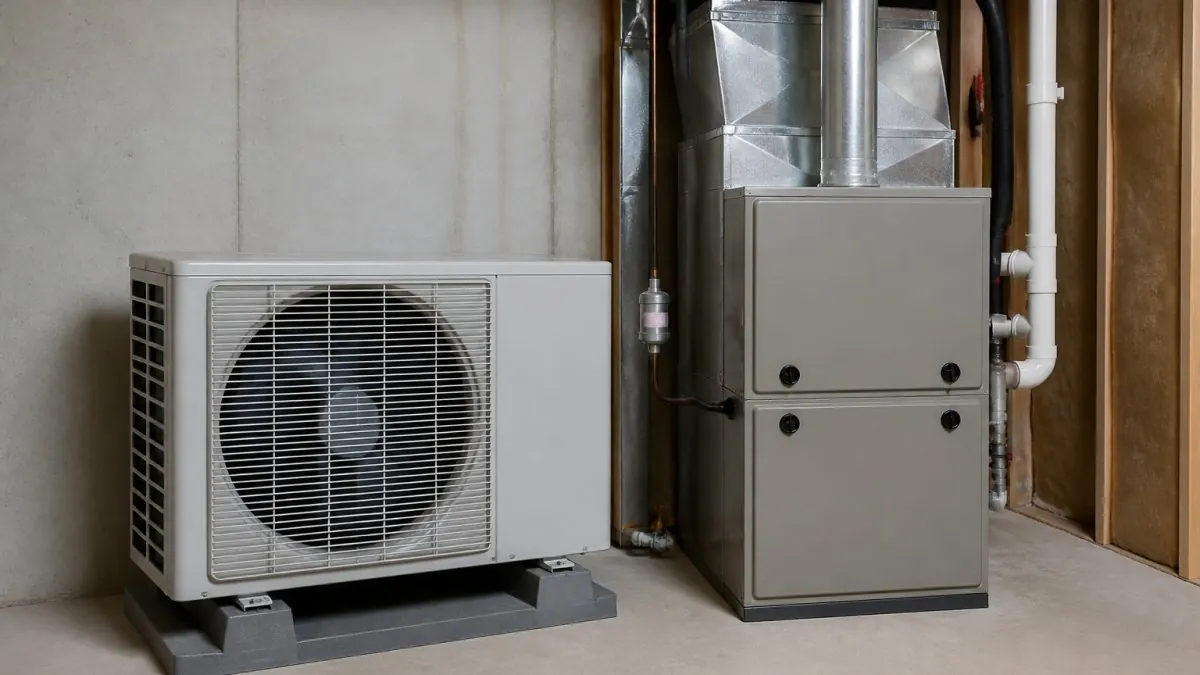
A heat pump is an electric system that transfers heat rather than generating it, which lets it deliver more heating energy than the electricity it consumes. A furnace is a combustion or electric-resistance appliance that produces heat directly inside the unit.
Heat Pump vs Furnace Cost: Upfront Price and Operating Bills
Heat pump vs furnace cost splits into two very different numbers, and most homeowners fixate on the wrong one. The upfront price is a one-time hit; the operating bill recurs every month for 12 to 20 years. A system that costs $4,000 more to install but saves $40 a month pays that difference back in under nine years, and keeps saving after that.
Upfront and installed cost ranges
Equipment-only prices understate what you actually pay. A realistic installed-cost comparison includes labor, line sets, electrical work, and any duct or venting changes:
| Cost item | Heat pump | Furnace |
|---|---|---|
| Equipment + standard install | Roughly $4,500-$9,500 for a whole-home cold-climate unit | Roughly $2,500-$6,500 for a 80%-96% AFUE gas unit |
| Electrical panel upgrade (if needed) | Common on older homes, often $1,500-$3,500 | Rarely needed |
| New line set / refrigerant lines | Usually included; extra runs add cost | Not applicable |
| Ductwork modification | Sometimes needed for airflow | Sometimes needed for airflow |
| Flue / venting work | None (no combustion) | May be required for high-efficiency condensing units |
| Backup heat (strip kit or dual-fuel) | Often added in cold climates | Built in |
Those ranges are national planning figures, not quotes. Your number depends on tonnage, efficiency tier, and how much retrofit work your house needs. For real replacement pricing to benchmark your quotes, see our guide to the cost of HVAC system replacement, and we provide free estimates for most services before any commitment.
How to estimate your own operating bill
You can build a defensible estimate in about five minutes with three inputs: your delivered electricity price (cents per kWh, including supply and delivery charges), your delivered gas price (dollars per therm, including supply and delivery), and your home's annual heating load in BTU. The math:
- Heat pump annual cost = (annual heating BTU ÷ HSPF2) × electricity price per kWh, adjusted for your climate's rated performance.
- Furnace annual cost = (annual heating BTU ÷ (AFUE × 100,000 BTU per therm)) × gas price per therm.
A worked example makes the trade-off concrete. Take a home needing 60 million BTU of heat per season, a cold-climate heat pump rated HSPF2 9.0, electricity at $0.17/kWh, and a 95% AFUE furnace with gas at $1.30/therm:
- Heat pump: 60,000,000 ÷ 9.0 = 6,667 kWh × $0.17 ≈ $1,133 per season
- Furnace: 60,000,000 ÷ 95,000 = 632 therms × $1.30 ≈ $821 per season
In that scenario the furnace wins on operating cost, which is exactly why the answer flips by region. Run the same house with electricity at $0.12/kWh and gas at $1.60/therm and the heat pump comes out ahead. The lesson: don't accept a generic "heat pumps are cheaper to run" claim. Plug in your own rates.
Don't forget the cooling side
A furnace comparison that ignores summer is incomplete. A heat pump replaces both your furnace and your central AC, so the fair comparison is heat pump versus furnace-plus-AC. A separate central AC install typically runs $3,500-$7,000, and it carries its own maintenance and replacement cycle. When you fold that into the math, the heat pump's higher upfront price shrinks considerably, and in many cases disappears.
| Factor | Heat pump | Furnace |
|---|---|---|
| Upfront cost | Higher | Lower |
| Monthly operating cost | Depends on electric vs. gas rates | Tracks fuel prices |
| Summer cooling | Built in | Needs separate AC |
| Cold-climate output | Drops in deep cold; backup needed | Steady |
| Lifespan | 12-15 years | 15-20 years |
Rebates and incentives change the math
Federal tax credits for qualifying heat pumps, plus state and utility rebates, can offset a meaningful share of the installed price. Ask your contractor for a line-item list of incentives you qualify for before comparing quotes, the post-incentive number is the one that matters.
Heat Pump Efficiency in Cold Weather
Heat pump efficiency in cold weather is the question that decides most of these debates, and it's where most comparisons stay vague. The useful answer isn't "heat pumps work in the cold" or "heat pumps can't handle the cold." It's a curve: how much heating capacity a given unit delivers at 47°F, 17°F, and 5°F, and where that curve crosses your home's heat loss.
Capacity and efficiency by outdoor temperature
Manufacturer performance data for cold-climate heat pumps follows a consistent pattern. At mild temperatures the unit runs at or near its rated capacity and its highest efficiency. As outdoor air drops, both capacity and coefficient of performance (COP) decline, but modern cold-climate units hold up far better than standard models:
| Outdoor temp | Typical cold-climate heat pump | Typical standard heat pump |
|---|---|---|
| 47°F | ~100% of rated capacity, COP around 3.5-4.0 | ~100% of rated capacity, COP around 3.0-3.5 |
| 17°F | ~70-80% of rated capacity, COP around 2.0-2.5 | ~50-60% of rated capacity, COP around 1.5-2.0 |
| 5°F | ~55-70% of rated capacity, COP around 1.5-2.0 | Often below 40%, COP near 1.0-1.5 |
| Below 0°F | Some models continue; capacity and COP fall further | Usually relies on backup heat |
A COP of 2.0 means the heat pump delivers two units of heat per unit of electricity, still roughly twice as efficient as electric resistance backup, which is COP 1.0 by definition. That's why the backup-heat question matters so much: when the heat pump can't keep up, the strip kit runs at COP 1.0 and your electric bill spikes.
What the balance point means for your house
Your home's heat loss at design temperature (the coldest expected outdoor temp for your area, commonly in the single digits to low teens in cold-climate regions) determines how much capacity you need. If the heat pump's capacity at that temperature meets or exceeds your heat loss, you may need little or no backup. If it falls short, the difference is made up by backup heat, and the cost of that backup depends on whether it's electric resistance (expensive) or a gas furnace in a dual-fuel setup (cheaper per BTU in most markets).
What the efficiency ratings actually mean
Three ratings tell the real story. HSPF2 measures heating efficiency across a season, SEER2 measures cooling efficiency, and AFUE measures how much fuel a furnace converts to heat. A higher HSPF2 means cheaper winter operation; a higher AFUE means less gas wasted up the flue. HSPF2 is a seasonal average, though, it doesn't tell you how the unit behaves at 5°F. If you want to decode these numbers in depth, our guide on how to choose the right HVAC efficiency rating breaks down SEER2, AFUE, and HSPF2 side by side.
The practical takeaway
In a mild-to-moderate climate, a standard heat pump handles nearly all of the heating load and the backup rarely runs. In a genuinely cold climate, the right answer is usually a cold-climate heat pump sized with a load calculation, paired with either a modest electric strip kit or a gas furnace for the handful of design-condition days. That's not a compromise, it's how the equipment is designed to be applied.
Dual Fuel Heat Pump System: When a Hybrid Setup Makes Sense
A dual fuel heat pump system pairs an electric heat pump with a gas furnace and switches between them based on outdoor temperature.
The trade-off is complexity. In older houses with questionable insulation or ductwork, a heat pump's real-world performance can disappoint, so it pays to understand whether a heat pump is worth it for an older home before committing.
Heat Pump vs Furnace Lifespan and Maintenance
Heat pump vs furnace lifespan favors the furnace on paper: roughly 15-20 years versus 12-15 for a heat pump. But a heat pump runs year-round, providing both heating and cooling, so it replaces two appliances. Skipping maintenance is the fastest way to shorten either lifespan, and our honest analysis of whether HVAC maintenance is worth it explains why the math favors keeping up with it.
Comfort, Cooling, and Whole-Home Considerations
Comfort is where heat pumps quietly win. A heat pump delivers steady, gentle warmth and doubles as central air conditioning, so you get year-round comfort from one system. Furnaces heat fast but dry out the air and leave you buying a separate AC unit. Ductwork quality, insulation, and thermostat setup affect both systems equally. Uneven upstairs bedrooms usually trace back to duct design, not the heat source itself.
Scheduling a Heating Assessment for Your Home
The right call comes down to your house, your fuel options, and your budget, not a generic rule. That is exactly what our licensed, insured technicians do, backed by over 30 years as a family-owned business and free estimates for most services. Schedule a heating and cooling assessment with Rich's Plumbing Heating & Air Conditioning and get a straight answer on whether a heat pump or furnace fits your home.
Frequently Asked Questions
Is a heat pump cheaper to run than a gas furnace?
It depends on local utility rates and how cold it gets. A heat pump moves heat instead of burning fuel, so it can deliver more heating per dollar of electricity than a furnace delivers per dollar of gas. In very cold snaps, a standard heat pump may lean on supplemental heat, which shifts the math. Ask for a comparison using your own electric and gas rates.
Does a heat pump work well in cold weather?
Modern cold-climate heat pumps keep producing useful heat well below freezing, though capacity and efficiency drop as outdoor temperature falls. That is why heat pump efficiency in cold weather is measured at specific temperatures rather than as a single number. In colder regions, many homeowners pair a heat pump with a backup source so the system never struggles during a deep cold snap. A load calculation on your home shows what capacity you actually need.
Do you still need a furnace if you have a heat pump?
Not always. A properly sized heat pump can handle both heating and cooling for many homes, which is why it can replace a furnace and a separate air conditioner. In colder climates, some homeowners keep a furnace as backup in a dual fuel heat pump system, where the heat pump runs in mild weather and the furnace takes over when temperatures drop. The right answer depends on your climate, insulation, and existing ductwork.
How long does a heat pump last compared with a furnace?
Heat pump vs furnace lifespan is closer than most people expect. A well-maintained gas furnace commonly runs 15 to 20 years, while an air-source heat pump typically lasts 12 to 15 years because it runs year-round for both heating and cooling. Annual maintenance, filter changes, and correct sizing all affect how long either system lasts. A heat pump that handles both seasons does double duty, so tune-ups matter.
How much does a heat pump cost for a 2,000-square-foot home?
Pricing depends on the system size, efficiency tier, ductwork condition, and whether electrical upgrades are needed, so no single figure fits every home. A 2,000-square-foot house may need a different capacity than its square footage alone suggests once insulation and window quality are factored in. The reliable path is a free in-home estimate that includes equipment, labor, and any duct or electrical work, quoted in writing before you commit.
The choice between a heat pump and a furnace is really a choice about your home's fuel setup, insulation, and climate exposure, and guessing wastes money either way. Rich's Plumbing Heating & Air Conditioning brings over 30 years of family-owned experience, licensed and insured technicians, a fast 60-minute response time, and a 100% satisfaction guarantee to every assessment. Get started with Rich's Plumbing Heating & Air Conditioning and get a heating plan built around your actual house.