
Last Updated: November 6, 2026
Quick Summary
Comparing HVAC pricing means weighing flat-rate, hourly, and time-and-materials billing, because the model changes your final invoice as much as the repair itself. Flat-rate locks in a fixed price per job before work begins, while hourly billing charges for time on site plus parts and leaves you carrying the risk if the job runs long.
- Flat-rate pricing gives you a fixed price per job from a published price book, known upfront.
- Hourly quotes often stack a trip fee, diagnostic fee, one-hour labor minimum, and parts markup.
- A one-hour labor minimum means a 20-minute fix still bills as a full hour.
- Put every quote on the same footing for diagnosis, parts tier, scope, warranty, fees, and timeline.
- Rich's Plumbing Heating & Air Conditioning has served New Jersey homeowners since 1989 with free estimates for most services.
Table of Contents
- HVAC Pricing Models at a Glance: Flat-Rate vs Hourly vs Time-and-Materials
- What the Average HVAC Service Call Cost Per Hour Really Tells You
- Pros and Cons of Each Pricing Model for Homeowners
- How to Read a Residential HVAC Flat-Rate Pricing PDF
- Using a Comparing Residential HVAC Service Pricing Models Calculator
- HVAC Repair Estimate Comparison: A Like-for-Like Framework
- Pricing Red Flags and Consumer Protections to Know
- Schedule a Free Estimate from Rich's Plumbing Heating & Air Conditioning
- Frequently Asked Questions
HVAC Pricing Models at a Glance: Flat-Rate vs Hourly vs Time-and-Materials
Comparing HVAC pricing models starts with one fact: the billing method changes your final invoice as much as the repair itself.
Flat-rate pricing is a billing model where the contractor sets a fixed price per job before work begins, based on a published price book. You know the total upfront, and the number does not move if the job runs long.
Hourly pricing charges for time on site plus parts. Time-and-materials works the same way, with more itemized parts and labor detail. The FTC's consumer guidance on home improvement contracts is clear that written estimates protect you, so ask for one in whichever model you choose.
Quick Comparison Table: How Each Model Bills You
| Model | What You Pay | Price Known Upfront? | Risk If Job Runs Long | Best For |
|---|---|---|---|---|
| Flat-rate | Fixed price per job | Yes | Contractor absorbs it | Budget certainty |
| Hourly | Labor rate × hours + parts | No | You absorb it | Simple, quick fixes |
| Time-and-materials | Itemized labor + parts markup | Partially | Mostly you | Complex diagnostics |
Flat-rate pricing gives many homeowners a locked price before any work begins. Hourly billing can cost less on a fast fix, but an unexpectedly difficult repair can turn a bargain into a surprise.
What the Average HVAC Service Call Cost Per Hour Really Tells You
The average HVAC service call cost per hour is a misleading number on its own. It bundles the service call fee, diagnostic time, labor, and sometimes parts into one figure, so two contractors quoting the same "hourly rate" may be describing completely different things.
What matters is what the rate excludes. A low hourly figure often comes with a separate trip charge, a diagnostic fee, and parts marked up at the counter. A higher rate may already include the first hour, the diagnostic, and a stocked truck.
The Fee Stack Behind an Hourly Quote
An hourly quote is rarely just rate times hours. Most contractors stack several charges before labor begins:
- Trip or service call fee: a flat charge for the visit, commonly covering travel and the first few minutes on site. It is charged whether or not a repair is approved.
- Diagnostic fee: a separate charge for testing and fault isolation. Some contractors credit it toward the repair if you approve the work; many do not.
- Labor minimum: a one-hour minimum is common, so a 20-minute fix still bills as a full hour.
- Parts markup: the counter price plus a contractor margin, which varies widely and is rarely itemized on an hourly invoice.
- After-hours premium: a multiplier applied to the labor rate for evenings, weekends, and holidays.
Some quotes pair a modest hourly rate with a larger diagnostic fee and a one-hour minimum, so the headline rate can understate the final invoice.
Worked Example: The Same Repair Under an Hourly Quote
Consider a hypothetical capacitor replacement quoted hourly with a service call fee and a diagnostic fee. If the diagnosis and replacement together take well under an hour but a one-hour labor minimum applies, you pay for the full hour.
Run the arithmetic before you approve: rate × billed hours (respecting the minimum) + service call fee + diagnostic fee + parts with markup + any after-hours multiplier. That total, not the hourly rate, is what you are comparing.
Service Call Fees and Diagnostic Fees: What They Cover
The service call fee covers the visit itself: the technician's travel, time on site, and basic inspection. The diagnostic fee covers the testing that identifies the fault.
Watch out: a contractor who quotes an hourly rate but will not state the service call fee, diagnostic fee, and labor minimum in writing is giving you a number that is hard to compare against other quotes.
If you want to avoid paying for a diagnosis you never use, learn how to get a free heating repair estimate and see how fee-based visits differ from free estimates.
Pros and Cons of Each Pricing Model for Homeowners
Most pricing guides list pros and cons from the contractor's side. The homeowner question is narrower: which model changes my final bill, and by how much? Here is the honest breakdown we give customers who ask, framed around what actually lands on your invoice.
Flat-rate pricing
- Pros: Total known before work starts, no clock anxiety, easy to compare across contractors, discourages padded hours. The contractor absorbs the risk of a slow diagnosis, so a stubborn valve does not become your problem.
- Cons: Can price slightly higher on very simple jobs, and a vague price book hides what you are paying for. A flat rate is only as good as the task definitions behind it.
- When it changes your bill: on jobs where diagnosis time is unpredictable, flat-rate protects you. On a five-minute fix, it may cost more than an hourly minimum.
Hourly pricing
- Pros: Simple to understand, can be cheaper on quick repairs, transparent time tracking.
- Cons: You carry the risk of a slow diagnosis, and the final total is unknown until the technician stops. A one-hour labor minimum means short jobs still bill as a full hour.
- When it changes your bill: on a fast, well-defined repair, hourly can beat flat-rate. On a diagnostic-heavy call, the clock works against you.
Time-and-materials
- Pros: Fully itemized, fair on unpredictable jobs, good for complex or older systems where scope is unclear until the panel is open.
- Cons: Requires trust in the technician's pace, and parts markup is often buried. Itemization is only useful if you actually read the parts lines.
- When it changes your bill: on complex or older systems, time-and-materials can be the fairest model, provided the parts markup is disclosed.
The Homeowner Comparison Most Guides Skip
A common mistake is choosing the cheapest hourly rate. In practice, the lowest rate frequently belongs to the contractor with the largest diagnostic fee and the longest average visit.
To compare like for like, put every quote on the same footing before you decide:
- Same diagnosis written on every quote
- Same part quality tier: OEM versus aftermarket
- Same labor scope: repair only, or repair plus system check
- Same warranty length on parts and labor
- Same fees listed: service call, diagnostic, after-hours
- Same timeline and whether parts are stocked or ordered
When those six lines match, the pricing model becomes a secondary question. When they do not, you are comparing a full repair to a patch, and the cheapest headline number is meaningless.
How to Read a Residential HVAC Flat-Rate Pricing PDF
A residential HVAC flat-rate pricing PDF is a contractor's published price book, listing fixed prices for defined repair tasks by system type and complexity. Comparing fixed repair prices is more useful when you also weigh the system’s age, since HVAC system lifespans can shape whether a repair is a sensible investment.
Read it in this order. First, match the task description to your actual problem, since "capacitor replacement" and "blower motor replacement" are different line items. Second, check whether the price includes parts, labor, and disposal. Third, look for a system size or efficiency rating adjustment, because a larger or higher-efficiency unit may carry a different price. Fourth, confirm the warranty terms attached to each line.
Watch out: a price book with vague task names like "AC repair, minor" tells you nothing. Push for defined tasks with defined prices.
Using a Comparing Residential HVAC Service Pricing Models Calculator
A comparing residential HVAC service pricing models calculator converts quotes from different billing methods into one comparable number. You do not need software.
Enter the flat-rate quote as-is. For hourly quotes, multiply the rate by the estimated hours and add the service call fee, diagnostic fee, and parts. For time-and-materials, add the itemized labor and parts markup.
The result often surprises homeowners. A quote that looked cheaper on the hourly rate frequently lands above the flat-rate total once fees are added.
HVAC Repair Estimate Comparison: A Like-for-Like Framework
An HVAC repair estimate comparison only works when every quote describes the same job, the same parts, and the same scope. Otherwise you are comparing a full repair to a patch.
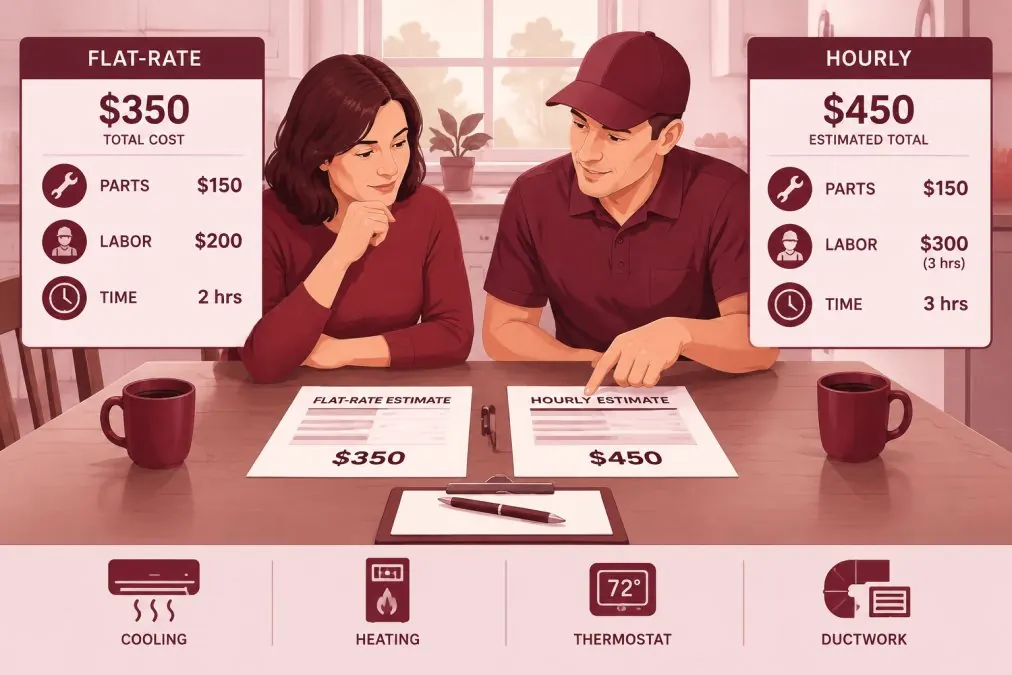
Use this framework for each estimate you receive:
- Same diagnosis written on every quote
- Same part quality tier: OEM versus aftermarket
- Same labor scope: repair only, or repair plus system check
- Same warranty length on parts and labor
- Same fees listed: service call, diagnostic, after-hours
- Same timeline and whether parts are stocked or ordered
If one contractor will not put the diagnosis in writing, that estimate cannot be compared. Before you decide between repairing and replacing, review the cost of HVAC system replacement in 2026 so you know the full picture.
Pricing Red Flags and Consumer Protections to Know
Pricing red flags in HVAC work usually appear before the technician arrives. A quote given over the phone with no inspection is a guess. A price that rises after the work begins, without your written approval, is a problem.
Consumer protections vary by state, so check your state's consumer affairs office and licensing board for contractor requirements and complaint procedures. The EPA's guidance on refrigerant handling also matters here, since refrigerant work is regulated and a proper quote should reflect certified handling.
Watch out: emergency and after-hours service legitimately costs more, but a contractor who inflates the emergency premium after arrival is using urgency against you. See how a competitor's model compares to a transparent alternative. Get the after-hours rate confirmed before dispatch.
Schedule a Free Estimate from Rich's Plumbing Heating & Air Conditioning
The pricing model matters less than the contractor standing behind the work.
If you are comparing quotes and want a straight answer on what your repair should cost, schedule heating repair service with a team that shows its pricing upfront.
Comparing pricing models is worth the effort because the difference between a fair invoice and an inflated one is usually the billing method, not the repair.
Frequently Asked Questions
What is the difference between flat-rate and time-and-materials HVAC pricing?
Flat-rate pricing quotes a set price for a defined job before work begins, so the total does not change if the repair runs long. Time-and-materials pricing bills you for labor hours plus parts and markup, so the final invoice depends on how long the job takes. Flat-rate makes HVAC pricing predictable for homeowners, while time-and-materials can cost less on quick fixes but more when a repair turns complicated.
How do HVAC companies price residential service calls?
Most companies charge a service call or diagnostic fee to cover travel and inspection, then quote the repair using either flat-rate or hourly billing. Some waive the diagnostic fee if you approve the repair. Ask upfront whether the fee is separate from the repair price, and request the quote in writing so you can compare the average HVAC service call cost per hour against the flat-rate total for the same job.
Is flat-rate HVAC pricing better for homeowners?
Flat-rate pricing gives you a known total before work starts, which makes budgeting easier and protects you from surprise charges if the job takes longer than expected. Hourly billing can be cheaper for simple, fast repairs. The better choice depends on the job: request both a flat-rate quote and an hourly estimate, then compare the totals for the same scope of work.
What should an HVAC repair estimate include?
A complete estimate should list the diagnosis, the specific parts and model numbers, labor, whether the service call fee is included, warranty terms on parts and labor, and the total price. For replacements, it should also state system size, efficiency rating, and permit costs. Use an HVAC repair estimate comparison checklist so every quote covers the same items before you decide.