Last Updated: November 7, 2026
Quick Summary
The quietest quiet hvac units for small townhouse spaces are ductless mini-splits, which put the noisy compressor outside and leave only a slim wall unit indoors. For a single small room, a quiet window unit like the Midea U is the lowest-hassle option. Portable units suit rooms with no usable window, but they take floor space and are usually louder.
- A unit rated quiet can still rattle a window frame or hum through a shared wall.
- Wirecutter has named the Midea U a top pick since 2020 and calls it one of the quietest models.
- A typical single-unit mini-split installation costs $3,000 to $5,000 including labor.
- Size rooms at roughly 20 BTU per square foot, adding capacity for top-floor rooms.
- A window AC in a required egress window can be a code violation even if the unit is quiet.
Table of Contents
- Why Townhouse Layouts Make Quiet HVAC Units Harder to Choose
- Quick Comparison: Quiet Cooling Options for a Small Townhouse
- Quiet Window Air Conditioner for a Small Room: What Works and What Doesn't
- Quiet 12,000 BTU Window Air Conditioner: When You Need More Capacity
- Quiet Ductless Mini-Split for Small Spaces: The Permanent, Whole-Room Option
- Portable Air Conditioners for Room-to-Room Cooling
- Quiet HVAC System Installation: Rules, Permits, and Townhouse Restrictions
- Sizing, Efficiency, and Total Cost of Ownership for a Townhouse
- Frequently Asked Questions
Why Townhouse Layouts Make Quiet HVAC Units Harder to Choose
Choosing quiet HVAC units for small townhouse spaces is harder than for a single-family house, because the layout works against you in ways a spec sheet never shows.
Homeowners often buy on the printed decibel number, then find the real noise comes from vibration through the wall, airflow past a tight corner, or a compressor cycling all night.
Below, we compare quiet cooling options for a small townhouse, room by room, with trade-offs.
Shared Walls, Narrow Rooms, and Sound That Travels
A window unit's compressor doesn't just make noise in your room; in a townhouse it transmits through the shared wall into a neighbor's bedroom. Most product pages ignore that.
Narrow rooms make it worse: a unit that sounds fine in an open living room feels loud in a 10-foot-wide bedroom, because sound bounces off two close walls. Placement matters as much as the rating.
What a Realistic Decibel Rating Actually Tells You
Manufacturer decibel ratings are measured in controlled conditions, usually at a set distance in open space. Real rooms add reflections, and real installs add vibration.
Treat the printed rating as a starting point, not a promise. Ask how the unit is mounted, whether the frame is insulated, and how the compressor behaves at low speed.
Quick Comparison: Quiet Cooling Options for a Small Townhouse
Here is the short version before the room-by-room detail. Each option fits a different townhouse situation, and none wins everywhere.
| Option | Type | Best For | Key Trade-off |
|---|---|---|---|
| Midea U | Window AC | One small room, lowest hassle | Cools a room, not the house |
| Midea Smart MAW08HV1CWT | Window AC, app control | Small space, smart control | Window needed; layout dependent |
| 12,000 BTU window unit | Window AC | Larger single room | More capacity, more noise risk |
| Ductless mini-split | Permanent, wall-mounted | Whole-room comfort, quietest feel | Higher upfront cost, install rules |
| Midea Duo portable | Portable AC | Rooms with no window option | Takes floor space |
Quiet Window Air Conditioner for a Small Room: What Works and What Doesn't
A quiet window air conditioner for a small room is the fastest fix for a townhouse, and often the smartest, as long as you accept its limit: it cools the room it sits in, not the floor.
Oversizing can cause problems. A unit too powerful for the room may cool fast, then short-cycle. Match capacity to square footage.
Midea U: The Long-Running Quiet Pick
The Midea U is the window unit that keeps showing up on shortlists for quiet operation. Wirecutter's air conditioner testing has named it a top pick since 2020 and describes it as one of the quietest models in ongoing testing.
Its U-shaped design lets the window close over the unit, which helps with both noise leakage and security. For a townhouse bedroom where the window faces a neighbor, that matters.
Best for: a single small room where you want quiet cooling without installation work. Skip if: you need to cool more than one room, or your window layout won't accept the frame.
Midea Smart MAW08HV1CWT: App Control in a Window Frame
The Midea Smart MAW08HV1CWT adds app control to the window format. TechGearLab's window AC testing calls it its best window AC for most people and notes quiet, energy-efficient operation.
Best for: small spaces where scheduling and remote control matter. Skip if: your townhouse windows are casement style or otherwise incompatible with a window frame unit.
Quiet 12,000 BTU Window Air Conditioner: When You Need More Capacity
A quiet 12,000 BTU window air conditioner is the right call when one room is larger than a bedroom, such as an open living-dining area on the ground floor.
Buying 12,000 BTU for a small bedroom "just in case" can lead to short-cycling and more noise. Size to the room.
If you need this capacity, look for variable-speed or inverter-driven models.
Quiet Ductless Mini-Split for Small Spaces: The Permanent, Whole-Room Option
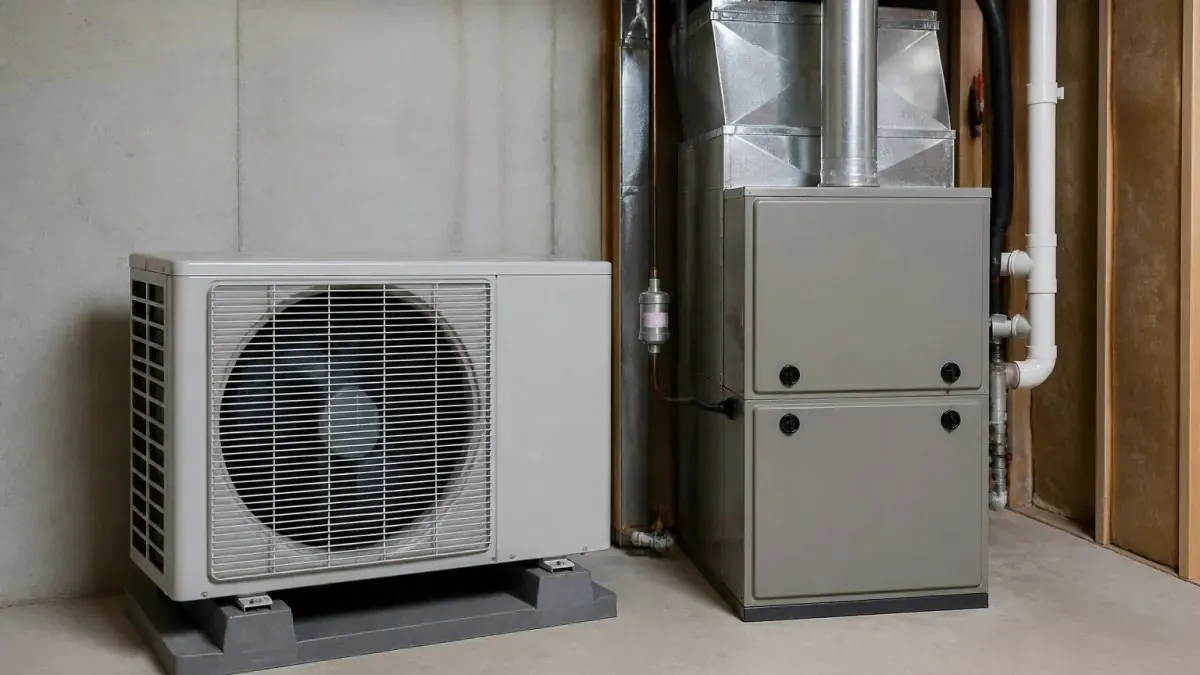
A quiet ductless mini-split for small spaces is the option that feels quietest in daily use, because the noisy compressor sits outside and the indoor air handler is a slim wall unit.
It's also the only option here that handles heating and cooling in one system, which suits townhouses with uneven upstairs temperatures.
What a Single-Zone Mini-Split Costs and Where It Fits
Budget honestly. Wirecutter's ductless mini-split guide reports a typical single-unit installation cost of $3,000 to $5,000 including labor.
For a townhouse, a single-zone system fits one problem room well. If you later want a second zone, our guide to what a multi-zone HVAC upgrade really costs breaks down the price factors before you commit.
Best for: homeowners who want the quietest daily experience and are ready for a permanent install. Skip if: you rent, or your townhouse association restricts exterior equipment.
Portable Air Conditioners for Room-to-Room Cooling
Portable air conditioners for room-to-room cooling solve a specific townhouse problem: rooms with no usable window, or renters who cannot modify anything. You wheel the unit where you need it and vent it through a window or slider.
The trade-off is floor space and, often, noise. The better models manage this well. Forbes Vetted's portable AC testing found the Midea Duo MAP14S1TBL cooled a hot, humid living room faster and more quietly than the other models it tested.
Best for: renters and rooms without a window-unit option. Skip if: you have a usable window and want the quietest result, since a window or mini-split unit usually wins on noise.
Quiet HVAC System Installation: Rules, Permits, and Townhouse Restrictions
Quiet HVAC system installation in a townhouse involves rules a single-family homeowner never faces: exterior equipment placement, shared-wall penetrations, window egress, condensate routing, and association approval all come before anyone drills a hole. Because placement and routing constraints can narrow the practical choices, BB O CONSTRUCTION CORP & HVAC can help connect those installation decisions with choosing a ductless mini split that fits the home.
Before you hire, confirm three things: whether your homeowner association requires approval for exterior units, whether a permit is needed, and who owns the shared wall you plan to penetrate. Skipping this step can lead to costly installation problems. Our guide to common HVAC installation mistakes covers the rest.
Window Egress and Why It Rules Out Some Window Units
A bedroom window is a life-safety exit, and many local codes and manufacturer instructions require that a window air conditioner not permanently block the clear opening.
Watch out: a window AC installed in a required egress window can be a code violation even if the unit is quiet and the install looks clean, so check the opening requirement before you buy the bracket.
Association Approval and Exterior Unit Placement
Many townhouse associations restrict exterior equipment by location, size, color, and visibility from the street. A mini-split condenser on a front-facing wall, or a window unit visible from the common area, may need written approval before installation.
Exterior placement also affects noise. A condenser on a bracket attached to a shared wall transmits vibration into the neighbor's unit; a ground-set pad on isolation feet, or a wall bracket with rubber isolators, reduces that path.
Shared-Wall Penetrations and Condensate Drainage
A mini-split line set has to pass through an exterior wall, and in a townhouse that wall may be a party wall you don't solely own.
Condensate is the other quiet failure. A drain line that runs to a shared exterior wall, or slopes the wrong way, can freeze in winter or back up in summer, and the resulting gurgle or water damage is a repair bill, not a comfort problem.
Electrical Capacity and a Written Timeline
A mini-split or larger window unit may need a dedicated circuit, and a townhouse panel that's already full means an electrician before an installer. Confirm available amperage at the planned location before the equipment arrives. Our guide to how long HVAC installation takes gives realistic timelines for a small townhouse.
What to Confirm Before Any Installer Touches a Wall
- Homeowner association approval for exterior equipment, in writing, with the approved location marked
- Local permit requirements confirmed with the authority having jurisdiction
- Window egress opening preserved for any window unit
Sizing, Efficiency, and Total Cost of Ownership for a Townhouse
Sizing and efficiency decide your total cost of ownership more than the purchase price does. A correctly sized unit runs less, lasts longer, and sounds quieter because it isn't fighting the room. The townhouse-specific angle most guides miss is that a narrow, multi-level home is not one cooling load but several, and the upper floor usually runs hotter than the square footage alone suggests.
A Practical Sizing Method for Narrow, Multi-Level Rooms
Start with floor area, then adjust. A common rule of thumb is roughly 20 BTU of cooling capacity per square foot for a standard room, then add capacity for ceilings above about 8 feet, large west- or south-facing windows, poor insulation, and top-floor rooms that absorb heat from the roof. In a townhouse, the top-floor bedroom often needs a step up in capacity even when it's the same size as the floor below.
Efficiency Ratings That Actually Apply
Use SEER2 for cooling efficiency and HSPF2 for heat pump heating performance. Higher numbers mean lower operating cost, but the right rating depends on your climate and how much you run the system. A mini-split that also heats in shoulder seasons can offset part of its higher purchase price through reduced heating cost, which a window unit cannot do. Our guide to choosing the right HVAC efficiency rating walks through the math.
Total Cost of Ownership, Line by Line
Total cost of ownership means purchase price plus installation plus energy over the unit's life, plus maintenance and expected replacement.
- Purchase: window and portable units are the lowest upfront; a single-zone ductless mini-split is the highest of the room-level options, with Wirecutter's ductless mini-split guide reporting a typical single-unit installation cost of $3,000 to $5,000 including labor.
- Installation: window and portable units are essentially self-install; a mini-split needs a licensed installer, an electrical check, and possibly association approval.
- Energy: compare estimated annual operating cost using the unit's efficiency rating and your local electricity rate, not the sticker price. A higher-SEER2 unit costs more upfront and less per hour.
Run the numbers over several years, not one season, and include the cost of cooling a second room if one unit will not cover the floor. If you want the broader picture before deciding, our guide to the best HVAC system for townhouses compares full-system options for these layouts.
Frequently Asked Questions
Which HVAC brand is the quietest for a small townhouse?
There is no single quietest brand across every product type. Some independent reviewers have named the Midea U among quiet window air conditioners, and some have reported favorable noise results for the Midea Duo portable unit. For ductless systems, noise depends on the specific indoor air handler and fan speed, so ask for the decibel rating at the setting you will actually use. A licensed installer can compare models for your rooms rather than a whole brand.
Are ductless mini-splits quieter than window air conditioners?
Ductless mini-splits generally run quieter because the compressor sits outside and only the indoor air handler is in the room. Window units put the entire compressor in your wall or window frame, so vibration and fan noise are closer to you. Ductless mini-split installation typically costs more than a window unit. For current pricing or a quote, visit Rich's Plumbing Heating & Air Conditioning's website. For a small townhouse bedroom, a quiet window air conditioner for a small room is often the practical first step.
How many BTUs does a small townhouse room need?
Cooling capacity is matched to square footage, ceiling height, window area, and how much sun the room gets. A 12,000 BTU window air conditioner is typically aimed at a larger single room than an 8,000 BTU model, which suits a small bedroom or office. Oversizing is a real problem in narrow townhouse rooms: the unit cools too fast, cycles on and off, and leaves the space clammy. An on-site assessment gives you a capacity number that fits the room instead of a guess.
Can an HVAC system be too large for a small townhouse?
Yes. An oversized system reaches the set temperature quickly and shuts off before it removes much humidity, so the room feels cold and damp. Short cycling also adds wear to the compressor and raises energy use over time. In a townhouse with several small rooms, a multi-zone or variable-speed system usually handles the load better than one large unit. Ask your installer to show the load calculation, not just a rule of thumb based on square footage.
Do I need permission to install a ductless mini-split in a townhouse?
Often yes. Shared walls, exterior mounting of the outdoor condenser, and drainage routes are usually governed by your homeowners association or condo documents, and local permit rules may apply to the electrical and refrigerant work. Before signing a contract, ask the installer to confirm what the association requires and who pulls the permit. A quiet HVAC system installation starts with those approvals, not with drilling the first hole.