Last Updated: November 4, 2026
Quick Summary
Exterior solar screens and double-cell cellular shades reduce solar heat gain most effectively, with exterior screens stopping heat before it reaches the glass. Solar shades, reflective film, and awnings also help, and the best choice depends on window orientation.
- South- and west-facing windows get the most direct sun and usually benefit most from treatment.
- A lower SHGC number means the window lets in less solar heat.
- Exterior screens must cover the full glass area and seal at the perimeter to perform well.
- Reflective film is a low-cost option that can be applied without replacing windows.
- Mount shades with a small air gap and fit them to the frame to block heat leaking around the edges.
Table of Contents
- Why Windows Let in So Much Heat and How Treatments Help
- How Solar Heat Gain Is Measured: Understanding the SHGC Rating
- The Best Window Treatments to Reduce Solar Heat Gain Compared
- A Cheap Way to Block Heat From Windows Without Replacing Them
- Thermal Window Coverings for Summer by Window Orientation
- Best Heat Blocking Blinds and Installation Details That Matter
- Choosing Your Window Treatment and Getting Help With Your Home's Cooling
- Frequently Asked Questions
Sunlight through a window can add more heat to a room than many homeowners expect, and that heat shows up on your cooling bill. The right window treatment can cut solar heat gain without replacing a single pane of glass. Rich's Plumbing Heating & Air Conditioning works with homeowners on cooling problems, and the window is often part of the picture. This guide compares the best window treatments to reduce solar heat gain, explains how the performance ratings work, and shows which options suit which windows.
Why Windows Let in So Much Heat and How Treatments Help
Solar heat gain is the amount of heat from sunlight that passes through a window and warms the inside of a home. Glass lets visible light through easily, and much of the energy in that light turns into heat once it hits furniture, floors, and walls.
Window orientation changes how much heat you take in. For more background on reducing heat through the building envelope, see U.S. Department of Energy guide to windows and energy savings.
How Solar Heat Gain Is Measured: Understanding the SHGC Rating
The solar heat gain coefficient, or SHGC, is the fraction of incident solar radiation that enters through a window as heat. It runs from 0 to 1. A lower number means the window lets in less heat.
Window coverings change the effective SHGC of the window system. A shade or film that blocks more solar energy lowers the effective coefficient more than a sheer curtain that blocks less. When you compare treatments, look for stated solar heat reduction or a published performance rating rather than general claims about being "energy efficient."
The Best Window Treatments to Reduce Solar Heat Gain Compared
Most homeowners choose among a few main categories. Each works differently, and each suits different windows and budgets. The table below summarizes how the main options compare on the metrics that matter for heat reduction, daylight, view, privacy, and suitability by window orientation. Actual performance varies by product, fit, and installation, so check each manufacturer's published ratings.
| Treatment | Typical effective SHGC reduction | Daylight | View | Privacy | Best orientations |
|---|---|---|---|---|---|
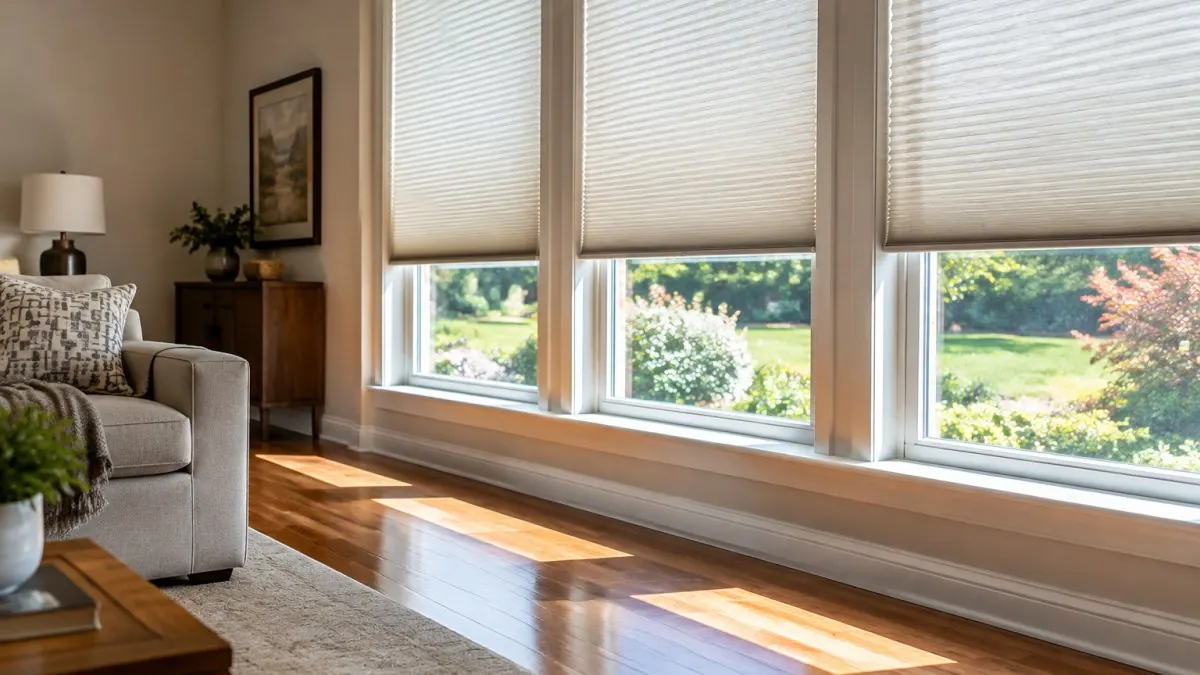
| Cellular / honeycomb shades (double-cell) | Moderate to high; insulating cells slow heat transfer in both directions | Adjustable | Low when closed | High | South, east, west |
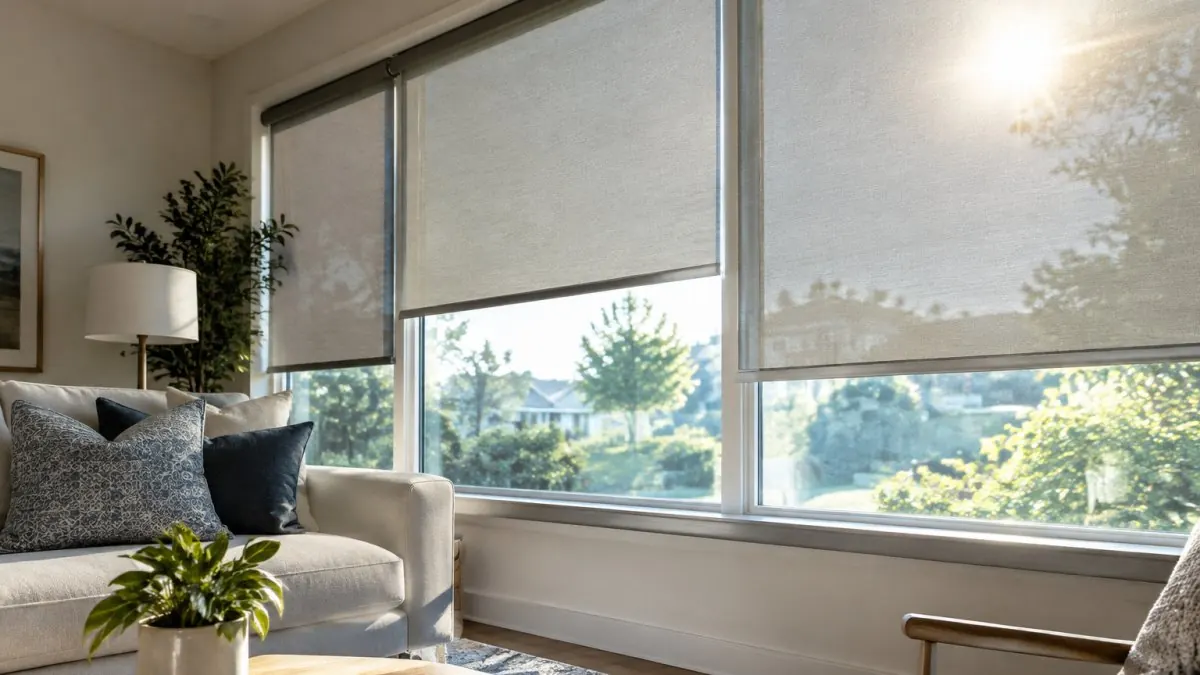
| Solar shades (woven, 3-10% openness) | Moderate to high; blocks a large share of direct sun before it reaches glass | Moderate | Good with open weaves | Moderate | South, west |
| Exterior solar screens | High; stops heat before it reaches the glass | Moderate | Good | Moderate | South, west |
| Reflective window film | Moderate; depends on film VLT and reflectivity | Reduced | Reduced on dark/reflective films | Low to moderate | South, west, east |
| Blackout curtains (lined) | Low to moderate; mainly blocks light and limits warm-air movement at the glass | Very low when closed | None when closed | High | Bedrooms, any orientation |
| Blinds (light-colored slats) | Low to moderate; reflects some sun when slats are angled | Adjustable | Adjustable | Adjustable | East, south, west |
| Exterior awnings | High for the shaded portion of the window | Reduced on shaded area | Preserved outside shaded area | Low | South, west |
Cellular and Honeycomb Shades: Trapped Air as Insulation
Cellular shades have fabric cells that trap air. That trapped layer slows heat transfer through the window in both directions, which is why they perform well in both summer and winter. Double-cell constructions add a second air pocket and generally outperform single-cell versions on insulation. They work well on bedroom and living room windows that face the sun for long periods.
- Best for: Windows that get heat all day and rooms where you want insulation year-round
- Pros: Strong insulating value, good light control, many fabric and light-filtering options
- Cons: Higher cost than basic blinds, and dust can collect in the cells
Solar Shades and Exterior Screens: Stopping Heat Before the Glass
Solar shades use a woven fabric that blocks a large share of sunlight before it hits the glass. The openness factor, commonly 1%, 3%, 5%, or 10%, describes how much of the view and light passes through; a lower openness blocks more heat and glare but darkens the room.
- Best for: South and west windows with heavy direct sun
- Pros: Blocks heat before it reaches the glass, keeps outdoor views visible
- Cons: Exterior units need proper mounting and can be damaged by high winds
Watch out: an exterior screen mounted with gaps at the sides or top lets hot air and sun slip around the fabric, which can erase much of the benefit.
Reflective Window Film and Blackout Curtains
Reflective window film and tinted films reflect a portion of incoming sunlight. They are applied to the glass and are a low-cost option for renters or homeowners who want a permanent change. Film performance is described by visible light transmittance (VLT) and by the film's effect on the window's SHGC; a darker or more reflective film lowers both, which cuts heat but also dims the room. Blackout curtains are different: they block light and some heat, mostly by reducing glare and warm air movement at the window.
- Best for: Budget-conscious projects (film) and rooms where light control matters most (curtains)
- Pros: Film is inexpensive and can be applied without a contractor; curtains are easy to change
- Cons: Some films can reduce daylight and interior views, and curtains alone block less heat than shades
Blinds, Shutters, and Awnings: The Remaining Options
Blinds reduce heat mainly by reflecting sunlight when slats are angled toward the sun; light-colored slats reflect more than dark ones. Interior shutters add a rigid barrier and a small air gap, which helps more than a thin blind.
- Best for: Blinds for flexible daily control; shutters for a permanent interior barrier; awnings for south and west exteriors
- Pros: Adjustable (blinds), durable (shutters), strong exterior shading (awnings)
- Cons: Blinds and shutters still sit inside the glass, so heat has already entered; awnings require mounting and wind consideration
When you compare treatments, look for stated solar heat reduction or a published NFRC performance rating rather than general claims about being "energy efficient." The metrics that matter most are SHGC (lower is better for heat), visible transmittance (higher means more daylight), and, for shades and films, the openness factor or VLT.
A Cheap Way to Block Heat From Windows Without Replacing Them
Replacing windows is expensive, so many homeowners look for a lower-cost fix first. Reflective film and well-lined curtains are the usual starting points. Closing south- and west-facing shades during the hottest part of the afternoon costs nothing and still makes a measurable difference.
Pricing for films, shades, and screens varies widely by size, material, and installation, so check current prices with the seller or installer before you budget. Our team can also tell you whether your windows are good candidates for a film or whether a shade will do more.
Thermal Window Coverings for Summer by Window Orientation
The best covering depends on which way a window faces, because orientation determines when and how much direct sun strikes the glass. The table below pairs each orientation with the treatment that typically performs best and the trade-off to expect.
| Orientation | Peak sun period | Recommended treatment | Why it works | Trade-off |
|---|---|---|---|---|
| South | Midday, year-round | Exterior solar screen or double-cell cellular shade | Blocks the strongest direct sun; cells slow heat transfer | Exterior screens need wind-rated mounting; cellular shades darken the room when closed |
| West | Afternoon and early evening | Exterior screen, solar shade (3-5% openness), or reflective film | Targets the hardest afternoon heat when AC runs longest | Lower openness cuts view and daylight |
| East | Morning | Light-filtering solar shade or light-colored blinds | Morning sun is less intense and easier to manage | Minimal heat benefit if left open during peak hours |
| North | Diffuse, indirect | Light-filtering shade or sheer | Little direct sun, so heavy treatment is usually unnecessary | Overspending on strong treatments yields little return |
East-facing windows get morning sun that is often easier to manage with a light shade. South-facing windows take the most sun across the day, so they benefit from exterior screens or insulating cellular shades. West-facing windows get the hardest afternoon heat, so they usually need the strongest protection.
Seasonal Trade-Offs in Mixed Climates
Most guidance emphasizes summer cooling, but the same treatment can penalize you in winter. South-facing windows deliver useful passive solar gain on cold, clear days; a permanently closed exterior screen or dark film blocks that benefit. A practical approach in mixed climates is to use adjustable interior coverings on south windows, open them on sunny winter days and close them in summer, and reserve fixed exterior shading for west windows, where summer afternoon heat dominates and winter solar gain is minimal. Because fixed shading can sacrifice winter sun, compare solar window film with adjustable screens in terms of how much seasonal control each allows.
Installation Details That Determine Real-World Performance
A treatment's rated performance assumes a good fit.
Watch out: a covering sized to the glass but not the frame often leaves a finger-width gap on each side, and that gap can undo a meaningful share of the heat reduction you paid for.
Best Heat Blocking Blinds and Installation Details That Matter
Blinds can reduce heat too, especially when they are mounted and used correctly. Light-colored slats reflect more sunlight than dark ones, and lowering blinds on the sunny side of the house helps most. Installation details matter. A shade or blind mounted with a small air gap from the glass traps heat better than one pressed flat against the window. Likewise, a covering that fits the window frame closely blocks more heat leaking around the edges.
Choosing Your Window Treatment and Getting Help With Your Home's Cooling
Start with the windows that get the most sun, match the treatment to each window's orientation, and choose the option that fits your budget and light needs. Window coverings are often the quickest way to reduce solar heat gain, but they are not the whole story.
If you need help with overall cooling, our licensed and insured technicians can inspect your system and recommend the right fix. For a full evaluation, contact our team and tap to schedule service today.
Frequently Asked Questions
How can I reduce solar heat gain from my windows?
Start with the windows that receive the most direct sun, usually south- and west-facing ones. Exterior solar screens and awnings block heat before it reaches the glass, which typically performs best. Interior options such as cellular shades with an insulating air pocket and reflective film also help. Closing shades during the hottest part of the day, and keeping them closed on sunny exposures, adds a low-cost layer of protection that many homeowners overlook.
What is the cheapest way to block heat from windows?
Closing existing curtains or blinds during peak sun hours costs nothing and reduces heat buildup. Adding lined drapes or applying reflective window film are typically low-cost upgrades. Pricing varies by product, window size, and installer, so check current prices with a supplier or contact Rich's Plumbing Heating & Air Conditioning for a quote before deciding.
Are thermal shades or blinds better for blocking heat?
Thermal cellular shades generally block more heat than standard blinds because their trapped air pockets slow heat transfer. Blinds with a reflective backing can also perform well, especially when tilted to deflect sunlight. The better choice depends on the window's orientation, how much light you want, and whether you need privacy, so compare the performance details for each product.
Do blackout curtains reduce heat from the sun?
Yes, blackout curtains reduce heat by blocking direct sunlight from entering the room. Their effectiveness improves when the lining is in direct contact with the glass and when the curtain is fully closed. They are less effective than exterior shading because some heat still builds up at the window before the curtain blocks it.